Data Scientist
Course in Hyderabad
A role-focused path through the Data Science Certification Program
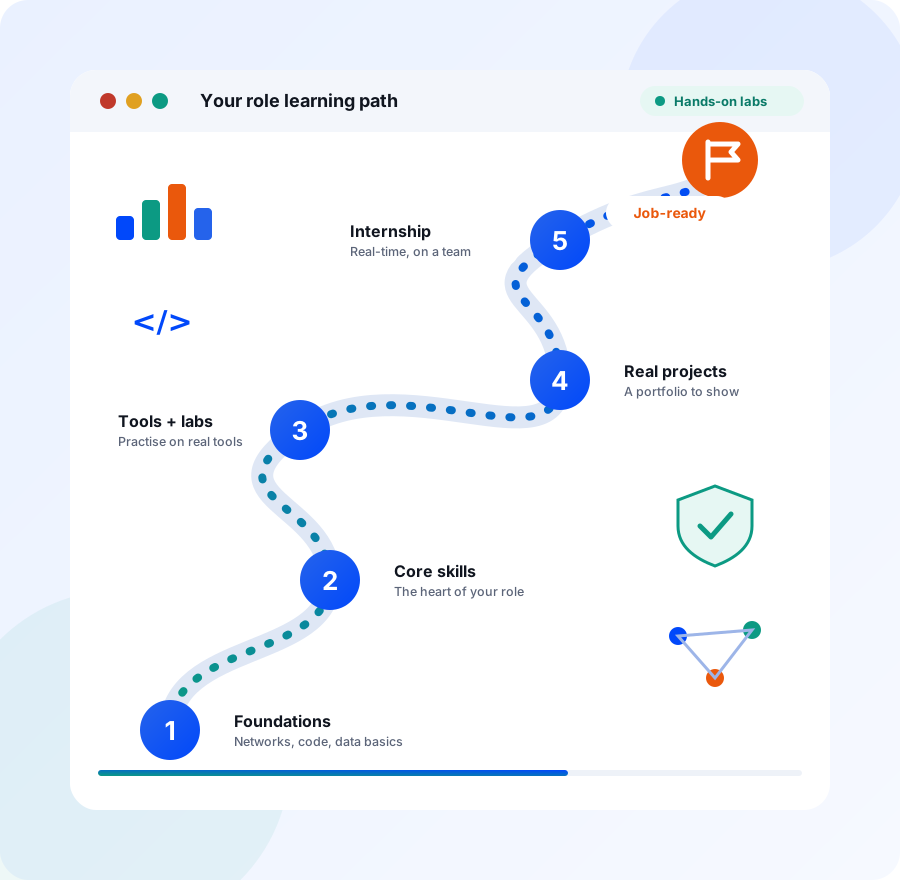
This role course arranges the Data Science programme around the work of a data scientist. You start with statistics and Python, move through data cleaning and exploration into machine learning, and finish by putting a trained model behind a working API or app.
- Statistical testing
- Python and Pandas
- SQL joins
- Data cleaning
- Exploratory analysis
- Scikit-learn models
- Model evaluation
- Flask and FastAPI
Same duration and fees as the Data Science programme.
What a Data Scientist does
A data scientist turns a business question into an answer that comes from data. A retail team may ask which customers are about to stop buying, or an operations team may want a demand estimate for next month. The data scientist checks what data exists, picks a suitable method, tests whether the result holds on new records, and explains it in words a manager can act on. It is part statistics, part programming and part communication.
Week to week, most of the time goes into the data, not the algorithm. You write queries, clean columns, look for odd values, compare groups and draw plots in a notebook. Once a question is well understood you try a simple model first, measure it honestly and only then try something stronger. Some days are spent with a stakeholder turning a vague request into a testable one, and other days are spent re-running an analysis because new data arrived with different problems.
Data scientists work in product companies, banks, healthcare, logistics, e-commerce, consulting firms and start-ups, and many of these have teams in Hyderabad. The role matters because decisions on pricing, stock, risk and customer offers are easier to defend when they rest on evidence. A good data scientist also knows the limits of the data and says so plainly, which protects a team from confident but wrong conclusions.
What you will be able to do
- Apply descriptive statistics, hypothesis tests and regression to a real dataset and interpret the result.
- Write Python with Pandas and NumPy to load, reshape and summarise tabular data.
- Extract and join data with SQL, then clean it into an analysis-ready table.
- Run a structured exploratory analysis and document the patterns and anomalies you found.
- Train and compare regression and classification models, and choose a metric you can justify.
- Spot overfitting with cross-validation and reduce it through feature selection.
- Package a trained model behind a Flask or FastAPI endpoint or a Streamlit app.
- Present a project end to end, from raw data to a working prediction, in your portfolio.
Who this course is for
Final-year or recent graduate
You have maths from school or college and want a first job in data. The course starts from statistics and Python basics, so you build a base before touching models, and you finish with projects you can show.
IT support or testing engineer
You already work in an IT team and know how systems behave. The Python, SQL and deployment modules give you a way to move from tickets and test cases toward analysis and prediction work.
Non-IT graduate
You studied commerce, science or arts and feel unsure about coding. Everything is taught from the start, with statistics explained through real datasets, so a non-IT background is a starting point and not a barrier.
Working professional in finance or operations
You already handle numbers in Excel and reports. This course takes that habit further into Python, statistics and models, so you can ask and answer deeper questions with data.
What you will learn as a Data Scientist
These are the Data Science programme modules that matter most for this role, in the order that suits it. Every topic, tool and lab below is part of the programme syllabus.
Mathematics for Data Science
Module 1 · 20 HrsA data scientist has to know why a result can be trusted. Concentrate on distributions, hypothesis tests, confidence intervals and regression, because these are the tools you will use to judge every later comparison and model.
See the full module →What you study
- Probability & statistics fundamentals
- Descriptive statistics & distributions
- Hypothesis testing & confidence intervals
- Correlation & regression basics
- Statistical inference for data decisions
Tools you use
NumPySciPyHands-on lab
Run a hypothesis test and interpret a confidence interval on sample data.
Python Programming
Module 2 · 30 HrsPython is the language every later step runs in. Spend your time on Pandas and NumPy and on writing tidy, reusable code, since a notebook that is messy or cannot be re-run is hard for a team to trust.
See the full module →What you study
- Python syntax, data types & control flow
- NumPy for numerical computing
- Pandas for data manipulation
- Working with virtual environments
- Writing clean, reusable Python code
Tools you use
PythonJupyter NotebookPandasHands-on project
Python Data Processing Script. Build a Python script that loads, cleans and summarises a real-world dataset using NumPy and Pandas.
Data Wrangling (SQL + Cleaning)
Module 3 · 20 HrsMuch of a data scientist's week goes into getting data into shape. Focus on joins, missing values, outliers and simple feature engineering, so the table you hand to a model is one you can defend.
See the full module →What you study
- Relational databases & SQL fundamentals
- SELECT, JOIN, GROUP BY & subqueries
- Handling missing values & duplicates
- Outlier detection & data standardization
- Feature engineering basics
- Building clean, analysis-ready datasets
Tools you use
SQLPandasMySQL / PostgreSQLHands-on lab
Clean a messy dataset — handling missing values, duplicates and outliers.
Exploratory Data Analysis (EDA)
Module 4 · 20 HrsExploration is where you decide what is worth modelling. Practise looking at one, two and many variables together, checking correlations, and turning early patterns into a hypothesis you can test and then explain in plain words.
See the full module →What you study
- Univariate, bivariate & multivariate analysis
- Summary statistics & data profiling
- Identifying patterns, trends & anomalies
- Correlation analysis between variables
- Hypothesis-driven data exploration
- Communicating early insights clearly
Tools you use
PandasJupyter NotebookPandas ProfilingHands-on project
EDA & Visualization Project. Explore a dataset end-to-end and present findings through Matplotlib and Seaborn visuals.
Machine Learning Fundamentals
Module 7 · 30 HrsThis is the predictive core of the job. Concentrate on choosing between regression, classification and clustering, splitting data properly, and reading precision, recall and F1, so you can explain why one model beats another.
See the full module →What you study
- Supervised vs. unsupervised learning
- Regression: linear & logistic
- Classification: KNN, Decision Trees, Random Forest
- Model evaluation: accuracy, precision, recall, F1
- Train-test split, cross-validation & overfitting
- Introduction to ensemble methods
Tools you use
Scikit-learnPandasJupyter NotebookHands-on lab
Apply cross-validation and feature selection to reduce overfitting.
Model Deployment
Module 8 · 20 HrsA model that stays in a notebook helps nobody. Learn to save it, serve it behind an API and think about monitoring and versions, so you can hand a working result to the people who need it.
See the full module →What you study
- Model serialization with Pickle / Joblib
- Building REST APIs for ML models
- Deploying models with Flask / FastAPI
- Model monitoring & versioning basics
- Building end-to-end ML pipelines
Tools you use
FlaskFastAPIStreamlitHands-on project
Deployment Project. Package a trained model into a working API or app deployed with Flask or Streamlit.
What the programme covers for this role. The programme covers statistics, Python, SQL, exploratory analysis, classical machine learning and deployment basics. Deep learning, big data platforms and time series forecasting are outside the syllabus, so plan to study them separately if a job asks for them.
Where a Data Scientist course can take you
Entry roles
Junior Data Scientist, Data Science Associate and Data Analyst (ML-focused) are the first titles the programme points to. Data Analyst roles are also a sensible way in while you build project experience.
Deployment-minded roles
If you leave with a deployed project, Applied Data Scientist and Data Scientist (Deployment-focused) roles come into view, along with entry-level ML and MLOps engineering for people who enjoy the serving side.
Longer-term paths
The programme's career map continues to Senior Data Scientist and Data Science Team Lead, and much further out to Chief Data Officer. These depend on years of work and results, not on a course alone.
Certifications the programme prepares you for
- IBM Data Science Professional Certificate
- Microsoft Certified: Azure Data Scientist Associate
- Google Data Analytics Professional Certificate
Data Scientist course, quick answers
Do I need a maths degree to become a data scientist?
No. The first module rebuilds the statistics, probability and calculus ideas you need, using NumPy, SciPy and real datasets. School-level maths is enough to start. What matters is practising until you can explain why a test or a model behaves the way it does.
Is Python or SQL more important for a data scientist?
You need both. Python with Pandas and NumPy handles analysis and modelling, while SQL is how you pull and join data from databases. Both are taught in the programme before machine learning begins, and SQL in particular is tested often in interviews.
Can a fresher become a data scientist?
Yes, usually as a Junior Data Scientist or Data Science Associate, if you can show real work. That is why the programme ends with projects and a real-time internship. No course can promise a job, but placement assistance includes resume, GitHub and LinkedIn help and mock interviews.
What projects should a data science portfolio have?
Aim for a statistical analysis brief, a cleaned real-world dataset, an exploratory analysis with visuals, a model with clear evaluation and a deployed app. These match the projects in the modules. A short write-up beside each one helps a reader see how you think.
Is deep learning part of this data science course?
The syllabus covers classical machine learning: regression, KNN, decision trees, random forests, clustering and ensemble methods. Deep learning is not listed among the modules. Learn the core methods and evaluation first, since they carry over to any later specialisation.
Get the Data Scientist Course Fee Structure & Syllabus
Share your details and our admissions team will call you back with the full syllabus, batch timings and fee breakdown.
Read before you decide
Other roles in the Data Science programme
Part of the Advanced Data Science Certification Program
Every role course follows the same Data Science programme, with the same modules, labs, projects and internship. See the full syllabus and every module.