
ML Engineer
Course in Hyderabad
A role-focused path through the Data Science Certification Program
This role course arranges the Data Science programme for an entry-level ML engineer. You build strong Python habits first, learn the machine learning methods and the maths behind them, prepare features, and then spend real time serving models through APIs, Docker and cloud basics.
- Clean Python code
- Scikit-learn models
- Model validation
- Feature engineering
- Joblib serialisation
- REST APIs
- Docker containers
- Cloud deployment
Same duration and fees as the Data Science programme.
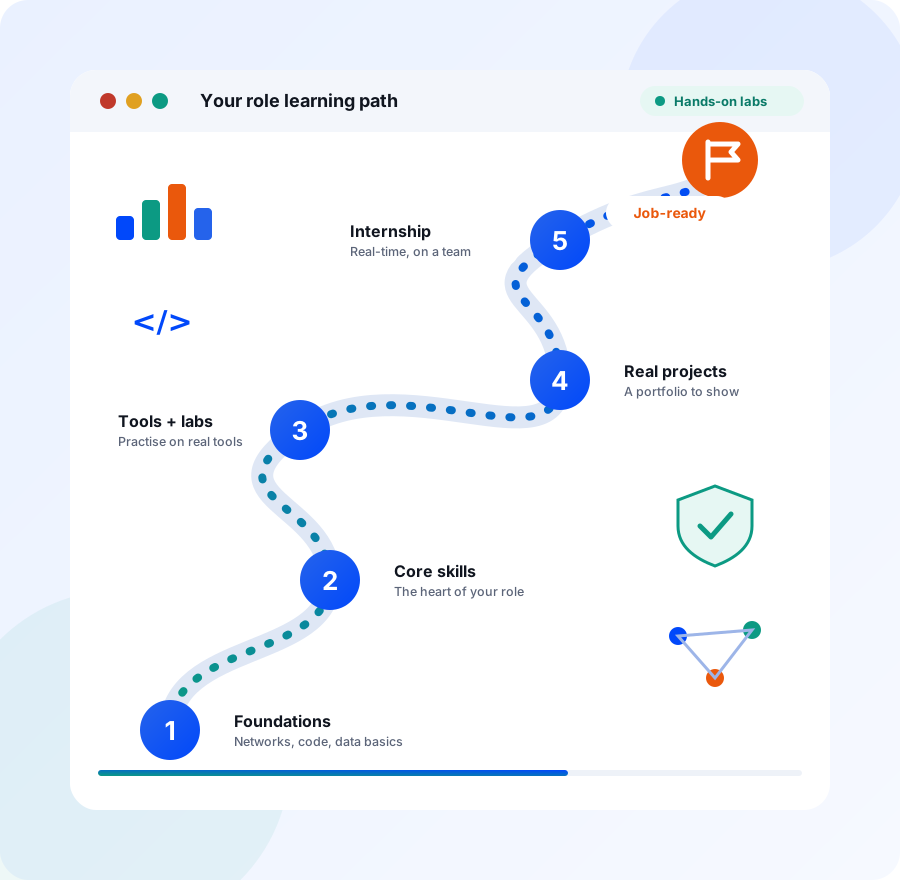
What a ML Engineer does
An ML engineer takes a model that works on a laptop and makes it work for real users. A data scientist may hand over a notebook that predicts which loan applications look risky. The ML engineer packages that model, wraps it in an API, tests it on new inputs and keeps it running. The work leans more on software habits than on statistics, though you still need to understand the model well enough to notice when its answers look wrong.
Week to week, expect to read other people's notebooks, rewrite them as clean Python modules, and set up virtual environments so the code runs the same everywhere. You retrain models when the data changes, compare versions, and fix an endpoint that fails on odd input. Some days go to Docker images and cloud deployments. Other days go to sitting with a data scientist to agree how the model should be evaluated before it goes live.
ML engineers work in product companies, fintech and health teams, e-commerce, IT services and start-ups that build prediction features into apps. The role matters because a model only creates value once someone can call it reliably. Teams often struggle more with shipping and maintaining models than with building them, so people who can do both are useful. At entry level, most of the job is careful, repeatable engineering.
What you will be able to do
- Write clean, reusable Python with functions, modules and a virtual environment for each project.
- Train regression, KNN, decision tree and random forest models with Scikit-learn.
- Evaluate a model with cross-validation, precision, recall and F1, and explain your choice.
- Explain the derivative and gradient idea behind a simple model update step.
- Prepare features by scaling, selecting and engineering columns from raw data.
- Serialise a model and serve it through a Flask or FastAPI REST endpoint.
- Containerise a model service with Docker and deploy it to a cloud platform.
- Describe how monitoring, versioning and pipelines keep a live model dependable.
Who this course is for
Final-year computer science student
You have programming basics from college and want a job closer to building software than to reporting. The Python and deployment modules give you a project showing that you can take a model all the way to a running service.
Backend or web developer
You already write code for services and APIs. The machine learning modules add the modelling side, while Flask, FastAPI and Docker will feel familiar and help you connect models to systems you know.
IT support or testing engineer
You know how applications break and how to test them. Learning Python properly, then modelling and deployment, gives you a route from support or testing toward entry-level ML and MLOps work.
Data analyst or working professional
You analyse data in Excel or SQL today and want to build things that run on their own. Start with Python and machine learning basics, then move to deployment, which changes the kind of job you can do.
What you will learn as a ML Engineer
These are the Data Science programme modules that matter most for this role, in the order that suits it. Every topic, tool and lab below is part of the programme syllabus.
Python Programming
Module 2 · 30 HrsSoftware habits come first for an ML engineer. Concentrate on functions, modules, exception handling, virtual environments and clean, reusable code, because production models are Python code that other people must read, run and fix.
See the full module →What you study
- Functions, modules & OOP basics
- File handling & exception handling
- NumPy for numerical computing
- Pandas for data manipulation
- Working with virtual environments
- Writing clean, reusable Python code
Tools you use
PythonVS CodePandasNumPyHands-on lab
Set up an isolated virtual environment for a data science project.
Machine Learning Fundamentals
Module 7 · 30 HrsLearn the standard models and, more importantly, how to test them honestly. Concentrate on the train-test split, cross-validation, overfitting, scaling and feature selection, and on reading precision, recall and F1, since these decide whether a model is safe to ship.
See the full module →What you study
- Regression: linear & logistic
- Classification: KNN, Decision Trees, Random Forest
- Model evaluation: accuracy, precision, recall, F1
- Train-test split, cross-validation & overfitting
- Feature scaling & feature selection
- Introduction to ensemble methods
Tools you use
Scikit-learnPandasNumPyHands-on lab
Build classification models using KNN, Decision Trees and Random Forest.
Mathematics for Data Science
Module 1 · 20 HrsYou do not need to derive everything, but you should understand what a model is doing. Spend time on vectors and matrices, regression, and derivatives and gradients, so a training step stops being a black box.
See the full module →What you study
- Linear algebra: vectors & matrices
- Probability & statistics fundamentals
- Correlation & regression basics
- Calculus for ML: derivatives & gradients
Tools you use
NumPySciPyHands-on lab
Work through gradient and derivative calculations behind a simple ML update step.
Data Wrangling (SQL + Cleaning)
Module 3 · 20 HrsModels are only as good as their inputs. Focus on feature engineering, merging and reshaping tables, pulling data from APIs and producing clean, repeatable datasets, since the same steps must run again whenever new data arrives.
See the full module →What you study
- SELECT, JOIN, GROUP BY & subqueries
- Merging, reshaping & pivoting datasets
- Feature engineering basics
- Working with APIs & scraped data
- Building clean, analysis-ready datasets
Tools you use
SQLPandasHands-on lab
Engineer basic features from raw columns for downstream analysis.
Model Deployment
Module 8 · 20 HrsThis is the heart of the role. Serialise a model, serve it with Flask or FastAPI, containerise it with Docker, deploy it to a cloud platform and learn the basics of monitoring, versioning and pipelines. Take the deployment project slowly and document it.
See the full module →What you study
- Model serialization with Pickle / Joblib
- Building REST APIs for ML models
- Deploying models with Flask / FastAPI
- Containerizing applications with Docker
- Deploying models to cloud platforms
- Model monitoring & versioning basics
- Building end-to-end ML pipelines
Tools you use
FlaskFastAPIDockerAWS / Azure BasicsHands-on project
Deployment Project. Package a trained model into a working API or app deployed with Flask or Streamlit.
What the programme covers for this role. The programme covers classical machine learning and the basics of deployment: APIs, Docker, cloud basics, monitoring and pipelines. Deep learning, large language models and dedicated MLOps platforms are outside the syllabus.
Where a ML Engineer course can take you
Entry roles
ML Engineer (Entry-Level) and ML / MLOps Engineer (Entry) are the starting points the programme lists. Data Science Associate and Backend Developer (ML-focused) suit people who lean toward analysis or software work.
Deployment-focused steps
Applied Data Scientist and Data Scientist (Deployment-focused) roles become realistic once you have a few deployed projects and can explain how each model is served, tested and monitored.
Longer-term paths
Over the years, the programme's career map points toward Senior Data Scientist and Data Science Team Lead. Which direction you take depends on whether you prefer building systems or leading analysis work.
Certifications the programme prepares you for
- Microsoft Certified: Azure Data Scientist Associate
- IBM Data Science Professional Certificate
- AWS Certified Data Analytics – Specialty
ML Engineer course, quick answers
What is the difference between a data scientist and an ML engineer?
A data scientist mostly explores data and builds models to answer questions. An ML engineer takes those models and makes them run reliably as services. At entry level the two overlap, and this course teaches both sides so you can choose later.
Do I need software development experience to become an ML engineer?
Some coding comfort helps, but you can start from the basics. The Python module covers syntax, functions, modules and clean code from the beginning. The deployment module then adds APIs and containers, so you build the engineering side in steps.
Will I learn Docker and cloud deployment?
Yes, at a basic level. The deployment module has labs on containerising a model service with Docker and deploying a model-backed app to a cloud platform, using AWS or Azure basics. It is a foundation for deployment work, not full cloud engineering.
Is the maths for machine learning too hard for a beginner?
It is manageable when you go step by step. The maths module covers vectors, probability, statistics and derivatives with labs on real data. You need enough to see what training does and to read evaluation results without guessing.
Which project shows that I can work as an ML engineer?
A model that runs as a service. Train a classifier, evaluate it properly, serve it through Flask or FastAPI and package it with Docker. The deployment project follows this shape, and a clear README explaining how to run it helps a hiring team see your work.
Get the ML Engineer Course Fee Structure & Syllabus
Share your details and our admissions team will call you back with the full syllabus, batch timings and fee breakdown.
Read before you decide
Other roles in the Data Science programme
Part of the Advanced Data Science Certification Program
Every role course follows the same Data Science programme, with the same modules, labs, projects and internship. See the full syllabus and every module.