Data Engineer
Course in Hyderabad
A role-focused path through the Data Science Certification Program
This role course takes the parts of the Data Science programme a junior data engineer relies on: SQL and data cleaning, Python scripts, data profiling and packaging services for deployment. It covers wrangling, not warehouse or big data tools, which the syllabus does not list.
- SQL joins
- Data cleaning
- Pandas reshaping
- API data pulls
- Python scripting
- Data profiling
- Docker packaging
- Cloud basics
Same duration and fees as the Data Science programme.
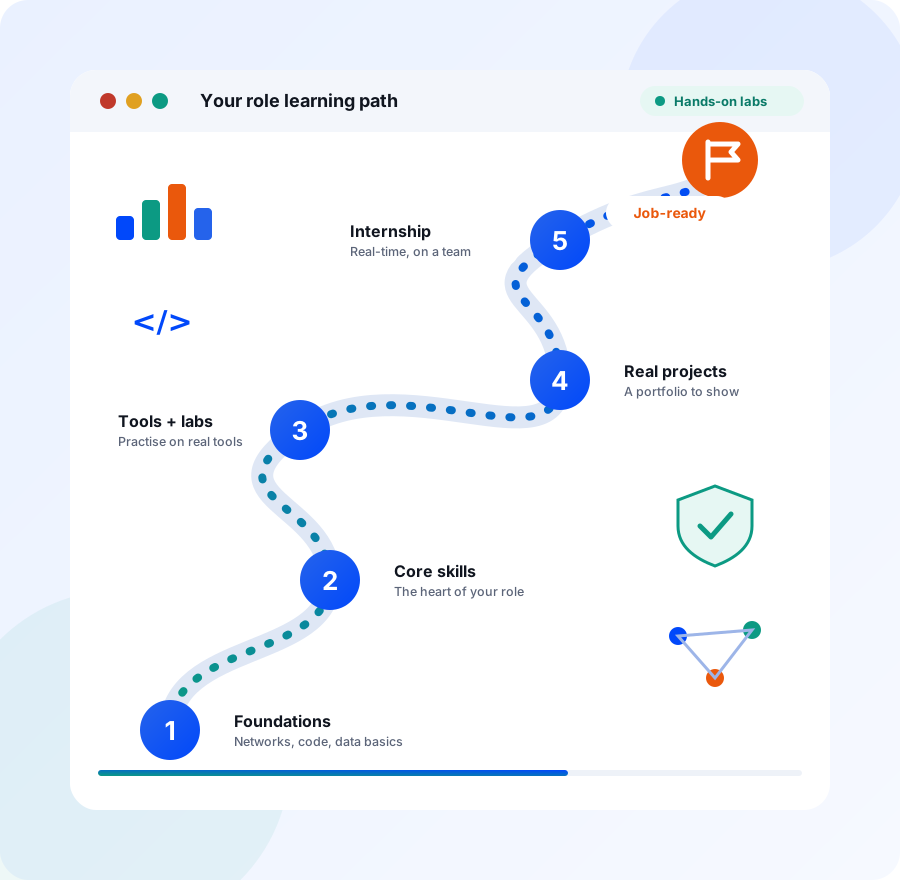
What a Data Engineer does
A data engineer makes sure the right data reaches the people who need it, in a form they can trust. Analysts and data scientists cannot work well if tables are missing rows, columns use different formats or files arrive late. The data engineer collects data from databases, files and APIs, cleans and combines it, and keeps the flow running. At entry level much of this is careful wrangling, done with SQL and Python, before larger systems come into play.
A normal week involves writing SQL to extract and join tables, and Python scripts that read files, handle errors and write tidy output. You check for duplicates and odd values, and you compare row counts before and after each step to make sure nothing was lost. When someone reports a wrong number, you trace it back through each stage. You also document what each step does so that a teammate can pick it up.
Data engineers work wherever data is collected in bulk: e-commerce, banks, telecom, logistics, healthcare, software products and IT services teams, many with offices in Hyderabad. The role matters because reports and models depend on the pipeline underneath. A small error at the start spreads into every dashboard downstream. Reliable data work is quiet, but the whole team feels it when it fails.
What you will be able to do
- Write SQL with SELECT, JOIN, GROUP BY and subqueries to extract data from relational databases.
- Clean a messy dataset by handling missing values, duplicates, outliers and inconsistent formats.
- Merge, reshape and pivot several sources into a single reliable table.
- Collect data from a public API and combine it with existing records.
- Write Python scripts with file handling, exception handling and a clean, reusable structure.
- Profile a dataset to report its structure, quality and key statistics.
- Containerise an application with Docker and run it on a cloud platform.
- Describe at a basic level how pipelines, monitoring and versioning fit together.
Who this course is for
Final-year computer or IT student
You like databases and scripting more than statistics. The SQL and Python modules give you a base for pipeline work, and the deployment module shows how such scripts run as real services.
IT support or database support engineer
You already handle systems, data files or reports. Learning SQL properly and Python scripting lets you move toward data pipeline work, where your habit of tracing faults is very useful.
Non-IT graduate
You are curious about data but new to coding. The course starts from the basics, and the wrangling focus gives you clear, practical tasks, such as cleaning a file or joining two tables, that build confidence.
Excel or reporting professional
You spend hours cleaning spreadsheets by hand each month. SQL and Pandas let you automate that work and scale it up, which is the first step toward data engineering tasks.
What you will learn as a Data Engineer
These are the Data Science programme modules that matter most for this role, in the order that suits it. Every topic, tool and lab below is part of the programme syllabus.
Data Wrangling (SQL + Cleaning)
Module 3 · 20 HrsThis module is the core of what the syllabus offers a data engineer. Concentrate on SQL joins, cleaning, merging and reshaping, pulling data from APIs and building clean, analysis-ready datasets, and treat the cleaning project as a small pipeline.
See the full module →What you study
- Relational databases & SQL fundamentals
- SELECT, JOIN, GROUP BY & subqueries
- Handling missing values & duplicates
- Merging, reshaping & pivoting datasets
- Working with APIs & scraped data
- Building clean, analysis-ready datasets
Tools you use
SQLMySQL / PostgreSQLPandasOpenRefineHands-on project
Data Cleaning Lab. Clean and prepare a messy real-world dataset using SQL and Pandas.
Python Programming
Module 2 · 30 HrsPipelines are mostly scripts. Focus on functions and modules, file handling, exception handling, Pandas, virtual environments and clean code, so your scripts fail loudly, run anywhere and can be read by others.
See the full module →What you study
- Functions, modules & OOP basics
- File handling & exception handling
- NumPy for numerical computing
- Pandas for data manipulation
- Working with virtual environments
- Writing clean, reusable Python code
Tools you use
PythonPandasVS CodeHands-on lab
Handle files and exceptions in a small Python data-processing script.
Exploratory Data Analysis (EDA)
Module 4 · 20 HrsProfiling is your data quality check. Use summary statistics, anomaly and outlier detection and automated profile reports to test a dataset before it goes to analysts, and note what you found for whoever uses it next.
See the full module →What you study
- Univariate, bivariate & multivariate analysis
- Summary statistics & data profiling
- Identifying patterns, trends & anomalies
- Outlier detection techniques
- Handling skewed distributions
Tools you use
PandasPandas ProfilingJupyter NotebookHands-on lab
Profile a real dataset and summarise its structure, quality and key statistics.
Model Deployment
Module 8 · 20 HrsHere the course moves from tables to running systems. Concentrate on Docker, cloud deployment, monitoring, versioning and end-to-end pipelines. The examples are built around ML models, so treat them as practice in packaging and running data services.
See the full module →What you study
- Model serialization with Pickle / Joblib
- Containerizing applications with Docker
- Deploying models to cloud platforms
- Model monitoring & versioning basics
- Handling real-time predictions
- Building end-to-end ML pipelines
Tools you use
DockerAWS / Azure BasicsFastAPIFlaskHands-on lab
Deploy a model-backed application to a cloud platform.
What the programme covers for this role. The programme covers wrangling with SQL and Pandas, data cleaning, Python scripting, profiling and deployment basics. Warehouse design, workflow schedulers and big data platforms are outside the syllabus, so this is a foundation for junior data engineering rather than the whole role.
Where a Data Engineer course can take you
Entry roles
Junior Data Engineer, ETL Analyst (Trainee), Data Wrangling Specialist and Python Developer (Trainee) are the starting titles the modules point to. Data Analyst roles are also a natural way in.
Building depth
After a year or two you can grow toward wider data engineering work. That means learning tools outside this syllabus, on the job or through separate study, once you know the fundamentals of SQL, Python and data quality.
Nearby paths
Deployment skills also open ML / MLOps Engineer (Entry) and Backend Developer (ML-focused) roles. Longer term, the programme's career map continues to Senior Data Scientist and Data Science Team Lead.
Certifications the programme prepares you for
- AWS Certified Data Analytics – Specialty
- Microsoft Certified: Azure Data Scientist Associate
- Google Data Analytics Professional Certificate
Data Engineer course, quick answers
Can I become a data engineer after this course?
You can start toward it. The course prepares you for junior and trainee roles such as Junior Data Engineer or ETL Analyst through SQL, cleaning, Python and deployment. Tools like Spark and Airflow are not in the syllabus, so expect to learn them on the job or separately.
Is SQL enough to become a data engineer?
SQL is the base, but not the whole job. You also need Python for scripts, care with data quality and some idea of how services are packaged and deployed. The course covers SQL and cleaning in depth, plus Python and Docker basics.
What is the difference between a data engineer and a data scientist?
A data engineer prepares and moves data so it is reliable. A data scientist uses that data to explore and build models. In this programme you learn both sides, and this path stresses wrangling, scripts and deployment.
Does this course teach ETL?
It teaches the core of it: extracting data with SQL and APIs, cleaning and transforming it with Pandas and OpenRefine, and building clean datasets. It does not cover dedicated ETL or scheduling tools, so you will need extra learning for those.
Which project should a data engineering beginner build?
A data cleaning project that pulls from a database and an API, merges the sources, profiles the quality and writes a tidy output with a Python script. Add a README explaining each step. The Data Cleaning Lab in the course is a good start.
Get the Data Engineer Course Fee Structure & Syllabus
Share your details and our admissions team will call you back with the full syllabus, batch timings and fee breakdown.
Read before you decide
Other roles in the Data Science programme
Part of the Advanced Data Science Certification Program
Every role course follows the same Data Science programme, with the same modules, labs, projects and internship. See the full syllabus and every module.