
Threat Hunter
Course in Hyderabad
A role-focused path through the SOC Analyst Certification Program
This role course arranges the SOC Analyst programme around proactive hunting, the search for attackers that alerts have not caught. You begin with hunting methods and ATT&CK, then learn to search SIEM logs, study how attackers behave, and build the Windows, Linux and network knowledge that every hunt depends on.
- Threat hunting methods
- MITRE ATT&CK
- IOC and IOA
- Splunk searching
- Log analysis
- Threat intel feeds
- Windows investigation
- Wireshark packet checks
Same duration and fees as the SOC Analyst programme.
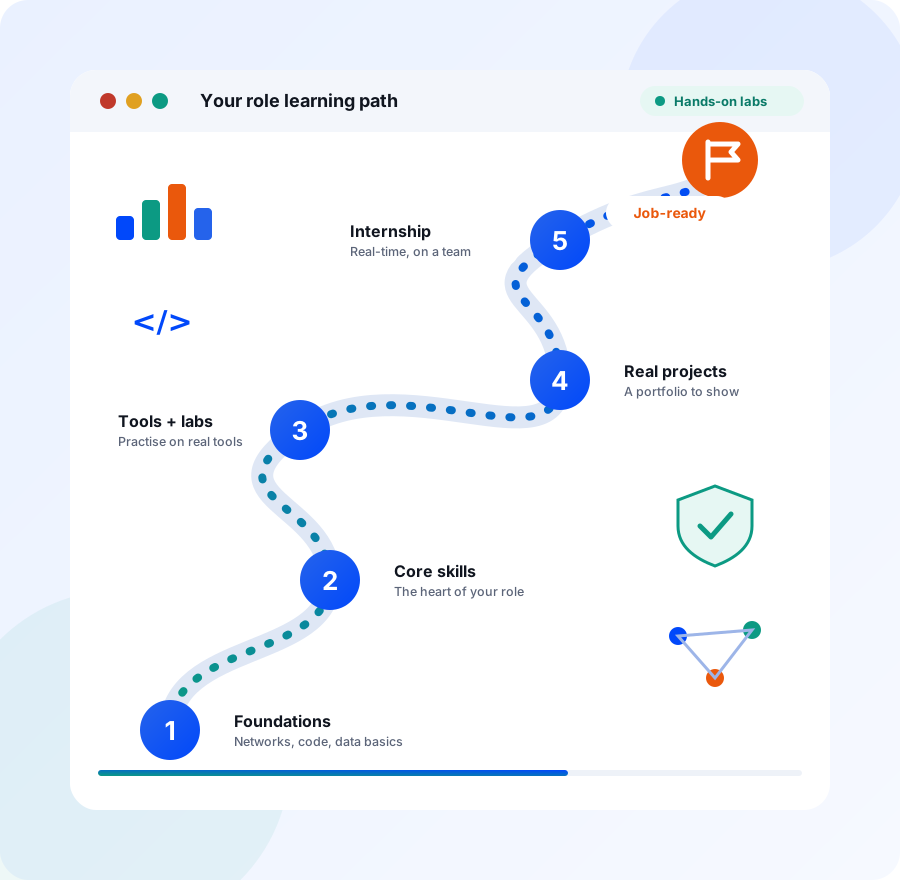
What a Threat Hunter does
A threat hunter looks for attackers who got past the alerts. Instead of waiting for a tool to fire, you start from a question, such as whether a known attacker technique could be happening in this network, and search the logs for signs of it. At entry level you work from an existing plan: a technique from MITRE ATT&CK, a set of indicators, a data source to search. What you find either answers the question or shows where detection is weak.
Week to week, you choose a technique or a fresh piece of threat intelligence, decide which logs could show it, and run searches in the SIEM. Most hunts find nothing dangerous, and that result is still recorded. When a hunt does turn up something odd, you check the host, the user and the network traffic, then hand it to incident response. Good hunters also turn what they learn into a suggestion for a new alert rule.
Threat hunters work in SOCs at larger IT services firms, banks, healthcare organisations and managed security providers, usually as part of an L2 or L3 group, and entry titles include Junior Threat Hunter. The work matters because attackers who blend in can stay unnoticed for a long time, and a hunt is often how a company finds out. Many people reach it after some time on the SOC queue.
What you will be able to do
- Explain the difference between reactive alert handling and proactive threat hunting.
- Plan a hunt around a MITRE ATT&CK technique and a matching data source.
- Search SIEM logs for signs of an attack technique and narrow the results.
- Use threat intelligence feeds and indicators to direct a hunt.
- Separate indicators of compromise from indicators of attack when reading evidence.
- Investigate a suspicious Windows host with Sysinternals and decode odd data in CyberChef.
- Document a hunt with its question, method, findings and follow-up actions.
- Hand a confirmed finding to incident response with the evidence attached.
Who this course is for
Final-year student
You like puzzles and reading data. Hunting is rarely a first job, so plan to build SOC queue skills through the early modules and treat the hunting project as your portfolio piece.
IT support engineer
You know how healthy Windows machines, users and networks behave, which is what a hunter compares against. Add SIEM searching and attacker techniques, and you can start spotting what looks wrong.
Non-IT graduate
The foundation module comes first for everyone, and hunting leans on it because you must know what normal looks like. Expect a longer road, and use a habit of careful, patient reading to your advantage.
Working SOC analyst
You already see alerts and wonder what they miss. This path gives you a method, ATT&CK to organise it and a hunting project that shows you can go beyond the queue.
What you will learn as a Threat Hunter
These are the SOC Analyst programme modules that matter most for this role, in the order that suits it. Every topic, tool and lab below is part of the programme syllabus.
Incident Response & Threat Hunting
Module 5 · 50 HrsHunting lives here. Learn hunting methods, the Kill Chain and ATT&CK and the CTI lifecycle, then practise separating IOCs from IOAs. Put most of your effort into the hunting project, since it is the closest match to the daily work.
See the full module →What you study
- The Cyber Kill Chain and MITRE ATT&CK framework
- Cyber Threat Intelligence (CTI) and its lifecycle
- Indicators of Compromise (IOC) vs. Indicators of Attack
- Threat hunting methods & investigation tools
- Email header analysis & malware analysis basics
Tools you use
MITRE ATT&CKIOC / IOAKill ChainSysinternalsCyberChefHands-on project
Threat Hunting Project. Use MITRE ATT&CK and threat intelligence feeds to proactively hunt for hidden threats.
SIEM Platforms & Security Monitoring
Module 4 · 50 HrsYou can only hunt in data you can search. Learn what each log type contains, how sources reach the SIEM and how to read events in Splunk and QRadar. Focus on log types, log source integration and reference sets.
See the full module →What you study
- SIEM architecture, event & flow collectors
- Malicious IP communication & phishing analysis
- Windows, Linux & security device log types
- Reference sets, use-case creation & rule tuning
- Log source integration across the enterprise
Tools you use
SplunkIBM QRadarWin CollectFirewall LogsProxy LogsHands-on lab
Analyse malicious IP communication and phishing activity using live SIEM offense data.
The Cyber Threat Landscape
Module 2 · 30 HrsHunting questions come from knowing how attackers work. Study the five phases of hacking, malware behaviour, phishing and password attacks so you can predict what traces each step would leave in the logs.
See the full module →What you study
- The five phases of hacking: recon to clearing tracks
- Malware types: viruses, worms, trojans & ransomware
- Phishing, spear-phishing & business email compromise
- Password attacks, MITM, DoS & DDoS attacks
- Web application attacks: injection, XSS & more
Tools you use
WiresharkNmapCLIHands-on lab
Walk through the five phases of hacking against a simulated target.
Foundations: IT, Networking & Operating Systems
Module 1 · 30 HrsKnowing what is normal makes odd things stand out. Revisit networking, Windows and Linux administration and the command line so you can judge whether a process, connection or login is expected. Reputation checks help you follow up leads quickly.
See the full module →What you study
- Network topologies, devices & the OSI/TCP-IP models
- IP addressing, classifications & subnetting
- Routers, switches, firewalls & IDS/IPS placement
- Windows & Linux installation and administration
- Linux terminal / CLI & command-line practice
- Reputation checks for suspicious IPs & URLs
Tools you use
WiresharkWindows ServerLinux / UbuntuCLIHands-on lab
Capture and analyse network traffic using Wireshark.
What the programme covers for this role. The programme teaches hunting methods, ATT&CK, IOC and IOA and a hunting project at a junior level. Deep malware reverse engineering and writing your own detection code are outside its syllabus.
Where a Threat Hunter course can take you
SOC Analyst (L1)
Hunting is normally not a first job. Start on the queue as a SOC Analyst (L1) or Security Monitoring Analyst, where you see what real alerts and false alarms look like.
SOC Analyst (L2)
At L2 you investigate across logs and hosts, the same skills a hunt uses. Take part in any hunting exercises your team runs, and keep a record of the ones you do.
Junior Threat Hunter
The programme's final module lists Junior Threat Hunter as a role it prepares you for, within the Incident & Threat Response track. Expect to work from plans set by more senior hunters at first.
Senior paths
Longer term, hunters can move toward Threat Intelligence Analyst, Incident Response Analyst or SOC Team Lead roles, depending on whether they prefer research, response or managing people.
Certifications the programme prepares you for
- CompTIA CySA+
- Microsoft Security Operations Analyst (SC-200)
- GIAC Certified Incident Handler (GCIH)
Threat Hunter course, quick answers
Can a fresher become a threat hunter?
Junior roles exist and the programme prepares you for one, but most people first spend time on the SOC queue. Hunting needs a sense of what normal looks like, and that comes from watching real alerts and logs. Use the hunting project to show your method.
How is threat hunting different from normal SOC monitoring?
Monitoring reacts to alerts that tools raise. Hunting starts with a question and goes looking for attackers the alerts missed. The SOC module lists hunting as one of its key functions, and the final module teaches methods, ATT&CK and a hunting project.
Does the course teach MITRE ATT&CK for hunting?
Yes. The incident response and hunting module covers the Cyber Kill Chain and MITRE ATT&CK, IOC versus IOA and hunting methods. The hunting project uses ATT&CK and threat intelligence feeds to search for hidden threats, so you practise applying it rather than only reading about it.
Do threat hunters need to write code?
Not at the level this course teaches. The hunting work here uses SIEM searches, ATT&CK and threat intelligence, and programming is not part of the syllabus. Scripting can be useful later, so you may choose to learn it separately as you progress.
What tools does a junior threat hunter use?
In this programme you use Splunk and IBM QRadar to search logs, MITRE ATT&CK and the Kill Chain to plan hunts, and Sysinternals, CyberChef and Wireshark to inspect hosts, data and traffic. Google Dorks are covered for open-source research on exposed information.
Get the Threat Hunter Course Fee Structure & Syllabus
Share your details and our admissions team will call you back with the full syllabus, batch timings and fee breakdown.
Read before you decide
Other roles in the SOC Analyst programme
Part of the Advanced SOC Analyst Certification Program
Every role course follows the same SOC Analyst programme, with the same modules, labs, projects and internship. See the full syllabus and every module.