
Security Monitoring Analyst
Course in Hyderabad
A role-focused path through the SOC Analyst Certification Program
This role course arranges the SOC Analyst programme around continuous monitoring: watching dashboards and log streams, deciding what deserves attention and reporting what you see. You start with the SIEM and the team model, then the network behind the logs and the attacks behind the alerts.
- Continuous monitoring
- SIEM dashboards
- Firewall log review
- Proxy log review
- IPS and WAF alerts
- Alert triage
- Wireshark basics
- Network basics
Same duration and fees as the SOC Analyst programme.
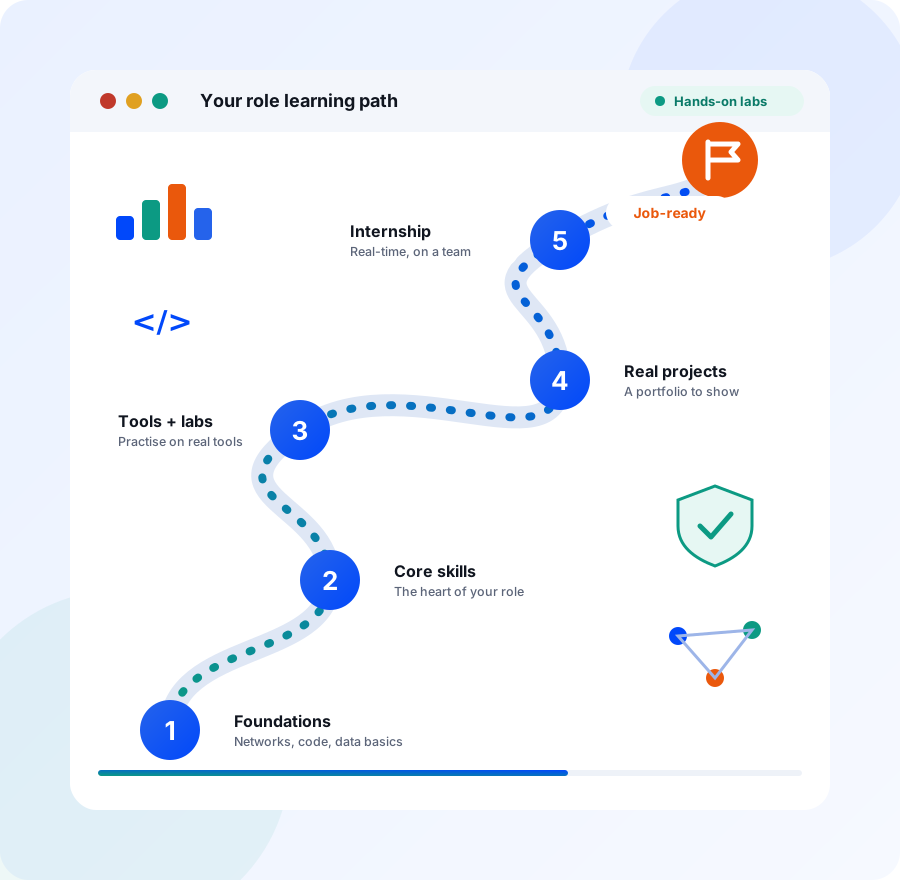
What a Security Monitoring Analyst does
A security monitoring analyst keeps watch. You follow dashboards, alert streams and device logs across the company's network and endpoints, and you decide what needs a closer look. The role sits at the front of the SOC: you see the first signs of something wrong, gather enough context to describe it and pass it to the right person. It suits people who stay focused for long stretches and notice small changes.
Week to week, you work in a shift rhythm. You check the health of the monitoring tools, scan dashboards for changes in firewall, proxy and intrusion prevention activity, and work through the alerts that appear. Each alert gets a quick check of the IP address or URL, a note and either a closure or an escalation. You also produce simple reports on what was seen, and flag when a data source stops sending logs.
Monitoring analysts work in SOCs and NOCs at IT services companies, banks, telecom and retail firms, and at managed security providers that watch many clients through one console. The role matters because attacks often show up first as small changes in traffic or logs. A monitoring team that notices early, and describes clearly what it saw, gives the rest of the security team a head start.
What you will be able to do
- Describe the essentials of security monitoring and how a SOC differs from a NOC.
- Build and read real-time SIEM dashboards that show where attention is needed.
- Read firewall, proxy, IPS and WAF logs and spot patterns of blocked or odd traffic.
- Triage alerts by separating false positives from real offenses, with a recorded reason.
- Run reputation checks on suspicious IP addresses and URLs and record the result.
- Explain where firewalls, IDS and IPS sit in a network and what each can see.
- Capture and inspect traffic in Wireshark to confirm what an alert describes.
- Recognise common attack types such as phishing, malware and password attacks in alert data.
Who this course is for
Final-year student
Monitoring is a sensible first step, and it rewards careful attention more than experience. This path gives you the SIEM and log skills to be useful in your first weeks on a shift.
IT support engineer
You already watch ticket queues and know what a healthy server looks like. Monitoring adds security logs, alert triage and reporting, and your habit of clear notes will help.
Non-IT graduate
Start with the programme's networking and operating system basics, since you cannot read a firewall log without them. The path then moves steadily from tools to dashboards to attacks.
Working NOC engineer
You watch network health today. The SOC module explains how the security side differs, and the SIEM module lets you carry your monitoring habits over to security alerts.
What you will learn as a Security Monitoring Analyst
These are the SOC Analyst programme modules that matter most for this role, in the order that suits it. Every topic, tool and lab below is part of the programme syllabus.
SIEM Platforms & Security Monitoring
Module 4 · 50 HrsMonitoring means living in the SIEM. Learn how events and flows are collected, how dashboards are built and how firewall, proxy, IPS and WAF logs look. Concentrate on dashboards, log types and telling false positives from real alerts.
See the full module →What you study
- SIEM architecture, event & flow collectors
- IBM QRadar: dashboards & offense analysis
- Windows, Linux & security device log types
- Correlation rules, false positives & alert triaging
- Generating governance & security reports
Tools you use
IBM QRadarFirewall LogsProxy LogsIPS / WAFSplunkHands-on lab
Build real-time SIEM dashboards and investigate offenses in QRadar.
Inside a Security Operations Center
Module 3 · 30 HrsSee where monitoring sits in the SOC. This module covers monitoring essentials, the split between NOC and SOC, and the tools that feed the console, such as NIDS, EDR and firewalls. Focus on the essentials and the tier structure.
See the full module →What you study
- Key SOC functions: triage, investigation & hunting
- How a SOC is structured and staffed
- Key SOC roles and responsibilities
- NOC vs. SOC — how the two teams differ
- Cyber security monitoring essentials
Tools you use
SIEMNIDS / NIPSEDR / XDRFirewallsSOARHands-on lab
Distinguish NOC responsibilities from SOC responsibilities in a shared scenario.
Foundations: IT, Networking & Operating Systems
Module 1 · 30 HrsLogs describe network traffic, so you need to read the network. Learn addressing, subnetting, where firewalls and IDS/IPS sit and how to check a suspicious IP or URL. Use Wireshark to see what an alert describes at packet level.
See the full module →What you study
- Networking essentials: LAN, MAN, WAN & Internet
- Network topologies, devices & the OSI/TCP-IP models
- IP addressing, classifications & subnetting
- Routers, switches, firewalls & IDS/IPS placement
- Reputation checks for suspicious IPs & URLs
Tools you use
WiresharkCLINmapHands-on lab
Capture and analyse network traffic using Wireshark.
The Cyber Threat Landscape
Module 2 · 30 HrsRecognising the pattern behind an alert speeds every decision. Focus on phishing, malware, password attacks, MITM and DoS, and what each looks like in traffic and logs, so your notes name the likely attack.
See the full module →What you study
- Threat, vulnerability & risk — how they connect
- Malware types: viruses, worms, trojans & ransomware
- Phishing, spear-phishing & business email compromise
- Password attacks, MITM, DoS & DDoS attacks
- Web application attacks: injection, XSS & more
Tools you use
WiresharkNmapCLIHands-on project
Threat Detection Exercise. Analyze malware, phishing emails and malicious IP activity using live SIEM offense data.
What the programme covers for this role. The programme teaches security monitoring through SIEM, log and alert work. Network performance monitoring tools used in a NOC are outside its syllabus.
Where a Security Monitoring Analyst course can take you
Security Monitoring Analyst
The SIEM and SOC modules list Security Monitoring Analyst and Alert Triage Specialist as target roles. In the Monitoring & Detection track, these are the front line of the SOC.
SOC Analyst (L1) and (L2)
Monitoring experience leads naturally to SOC Analyst (L1) and then (L2), where you investigate alerts rather than only flag them. The programme's SOC Operations track lists both, along with Security Analyst.
Log Analysis or SIEM engineering
If you enjoy the tooling more than the queue, the same track leads to Log Analysis Engineer, and the Security Engineering track to SIEM / Security Engineer, where you look after the platform itself.
SOC Team Lead
With years of experience, the Advanced Career Paths track points to SOC Team Lead, which adds scheduling, coaching and reporting to the monitoring skills you built earlier.
Certifications the programme prepares you for
- ISC2 Certified in Cybersecurity (CC)
- CompTIA Security+
- EC-Council Certified SOC Analyst (CSA)
Security Monitoring Analyst course, quick answers
What is the difference between a security monitoring analyst and a SOC analyst?
A monitoring analyst focuses on watching dashboards and alert streams, doing first checks and escalating. A SOC analyst, especially at L2, goes deeper into investigation and incident handling. The titles overlap at entry level, and the programme prepares you for both.
Is security monitoring a suitable first job for freshers?
Yes, it is a common entry point, and the programme lists Security Monitoring Analyst as a target role in its SOC and SIEM modules. The work is structured, so you learn from real alerts, and it builds the base for L2 and specialist roles.
What is the difference between a NOC and a SOC?
A NOC keeps networks and services running, watching for outages and performance problems. A SOC watches for security threats. The SOC module covers how the two teams differ, and a monitoring analyst needs to know which issues to route to which team.
Which logs does a security monitoring analyst read?
In this programme you read Windows and Linux logs plus firewall, proxy and IPS or WAF logs, as they arrive in QRadar and Splunk. You learn what each log type shows, and how correlation rules turn several events into one alert.
Do I need certifications to work as a security monitoring analyst?
Employers vary, and many care about hands-on skills too. The programme is structured to help you prepare for certifications such as ISC2 CC, CompTIA Security+ and EC-Council CSA, which are useful additions to your resume but not a substitute for practical labs.
Get the Security Monitoring Analyst Course Fee Structure & Syllabus
Share your details and our admissions team will call you back with the full syllabus, batch timings and fee breakdown.
Read before you decide
Other roles in the SOC Analyst programme
Part of the Advanced SOC Analyst Certification Program
Every role course follows the same SOC Analyst programme, with the same modules, labs, projects and internship. See the full syllabus and every module.