
Business Analyst
Course in Hyderabad
A role-focused path through the Data Analytics Certification Program
This role course arranges the Data Analytics programme around a business analyst who turns vague business needs into clear questions and measurable answers. You begin with problem framing and KPIs, add Excel and SQL to test ideas, and finish with a domain capstone that involves stakeholders.
- Problem framing
- KPI definition
- Stakeholder requirements
- Excel what-if analysis
- Lookup formulas
- SQL joins
- Executive summaries
- Domain case studies
Same duration and fees as the Data Analyst programme.
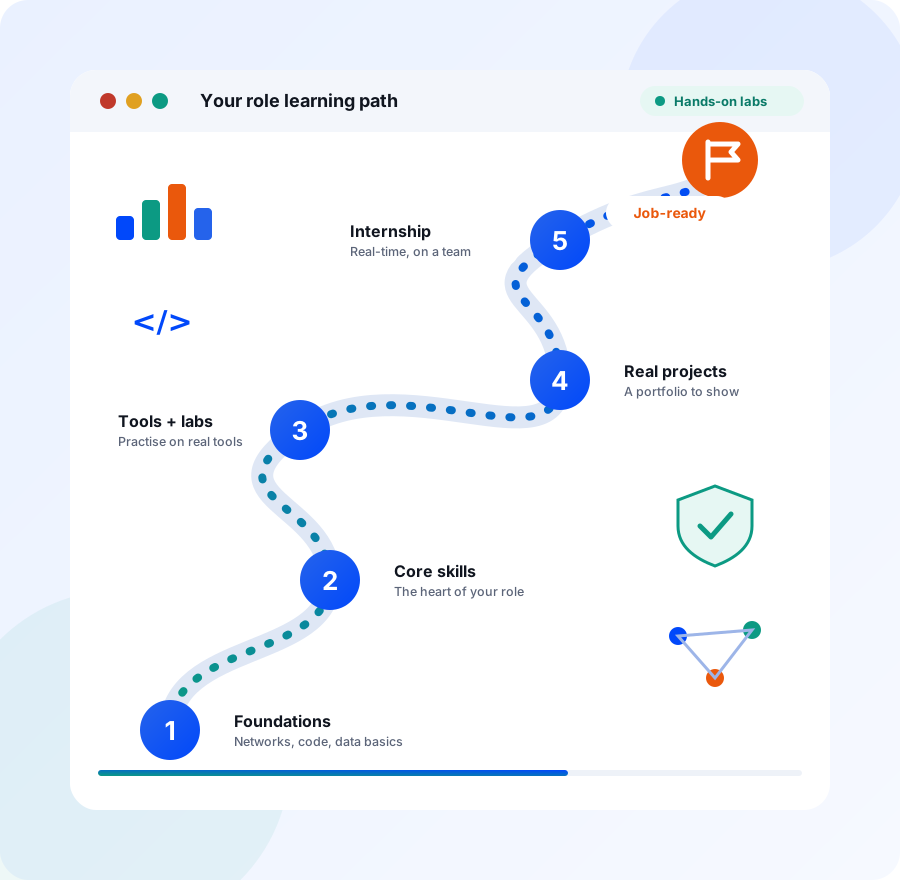
What a Business Analyst does
A business analyst sits between the people who have a business problem and the people who can supply data or build a solution. A sales head may say revenue feels flat. Your job is to ask what flat means, which region, which period, compared with what, and then work out which numbers and checks will show the answer. Good questions at the start save a great deal of effort later.
In a typical week you speak with two or three stakeholders, write down what they need in a short requirement note, and pull figures from Excel or SQL to test an early idea. You compare a few options using what-if scenarios, draft a summary with a recommendation, present it, and update it after questions and feedback. Between meetings you keep a running list of open questions so that nothing agreed in a hallway gets lost.
Business analysts work in banks, insurers, retail chains, hospitals, logistics firms, product companies and IT services teams. They matter because projects fail when nobody agrees on the real problem. A clear brief and a well-chosen metric save weeks of rework, and they give technical teams and managers a shared language. Many business analysts also become the person colleagues ask first when a number looks strange.
What you will be able to do
- Reframe a vague business request as a structured problem statement with clear data needs.
- Define KPIs that match a business goal and spot weak metrics in a case study.
- Use Excel lookups, pivot tables and what-if tools to test business ideas quickly.
- Write SQL queries that join and aggregate tables to check facts against source data.
- Gather requirements and work with stakeholders while completing a capstone project.
- Write an executive summary and present findings to a non-technical audience.
- Build a portfolio case study in a domain such as retail, finance, healthcare or marketing.
Who this course is for
Final-year student
You enjoy talking to people as much as working with numbers. The path builds problem framing plus basic Excel and SQL, so you can join a team as a junior business analyst with real project work to show.
IT support engineer
You already hear what users need and where processes break. You will add KPI thinking, requirement notes and data checks that help you move from fixing issues toward shaping what gets built.
Non-IT graduate
Commerce, management and science graduates often bring domain knowledge that technical candidates lack. Here you add structured analysis, Excel and SQL to that knowledge and practise presenting it.
Working professional
If you work in operations, sales or finance and are the person who explains the numbers, this path formalises it: framing questions, defining metrics and presenting clear recommendations to leaders.
What you will learn as a Business Analyst
These are the Data Analyst programme modules that matter most for this role, in the order that suits it. Every topic, tool and lab below is part of the programme syllabus.
Fundamentals of Data Analytics
Module 1 · 10 HrsThis module gives you the vocabulary and the habit of turning a fuzzy request into a clear problem. Concentrate on the analytics types, the lifecycle and how to structure a problem statement.
See the full module →What you study
- Introduction to data analytics & its business role
- Types of analytics: descriptive, diagnostic, predictive, prescriptive
- The data analytics lifecycle
- Data-driven decision making
- Structuring an analytics problem statement
Tools you use
ExcelGoogle SheetsPower BIHands-on lab
Structure a vague business question into a clear, answerable analytics problem statement.
KPI Tracking & Business Metrics
Module 8 · 10 HrsA business analyst is often asked which numbers matter. Focus on defining KPIs, aligning them with goals, avoiding common metric mistakes and communicating performance in plain language.
See the full module →What you study
- Defining KPIs & business metrics
- Aligning metrics to business goals
- Tracking trends over time
- Setting benchmarks & targets
- Common pitfalls in KPI design
- Communicating metric performance
Tools you use
ExcelPower BITableauHands-on lab
Identify and correct a poorly-designed KPI in a case study.
Excel for Data Analysis
Module 2 · 20 HrsExcel is the fastest way to test an idea before anyone builds a report. Concentrate on lookups, pivot tables, data validation and what-if scenarios, which let you compare options with real figures.
See the full module →What you study
- Pivot tables & pivot charts
- Data cleaning with Excel
- VLOOKUP, XLOOKUP & INDEX-MATCH
- Conditional formatting & data validation
- What-if analysis & scenario tools
Tools you use
ExcelPower QueryGoogle SheetsHands-on lab
Run a what-if analysis using Excel's scenario tools.
SQL for Data Analysis
Module 3 · 20 HrsYou do not need to be a database expert, but you should check facts at the source. Learn the SQL basics, joins, aggregates and subqueries, and write queries for business reporting questions.
See the full module →What you study
- Relational databases & SQL fundamentals
- SELECT, WHERE, ORDER BY & filtering data
- JOIN, GROUP BY & aggregate functions
- Subqueries & CTEs
- Writing queries for business reporting
Tools you use
SQLMySQL / PostgreSQLpgAdminHands-on lab
Join multiple tables and aggregate results using GROUP BY.
Domain Knowledge + Capstone Projects
Module 9 · 10 HrsThe capstone is where the role comes together. Frame a real problem, work with stakeholders and requirements, run the analysis in a domain like retail or finance, and present to a non-technical audience.
See the full module →What you study
- Applying analytics to real business domains
- Framing a business problem as an analytics project
- End-to-end capstone project execution
- Working with stakeholders & requirements
- Presenting findings to a non-technical audience
- Building a portfolio-ready case study
Tools you use
ExcelSQLPower BIHands-on lab
Frame a real business problem as a structured analytics project.
What the programme covers for this role. This programme is data-focused: it covers problem framing, KPIs, Excel, SQL and stakeholder communication. Formal requirement templates, process modelling notations and Agile delivery tools are outside its syllabus.
Where a Business Analyst course can take you
Entry roles
Junior Business Analyst, Research Analyst (Junior), Operations Analyst (Junior) and Reporting Analyst are the usual starting titles. You spend time gathering requirements, checking numbers and writing summaries for managers.
Next steps
After some experience, you can move to Business Analyst, Insights Analyst, Product Analyst or Process Analyst roles, taking on larger problems and working with several teams at once.
Longer term
Senior Data Analyst and Analytics Manager are the advanced steps in the programme's career tracks. Analysts with strong domain depth can also move toward Analytics Consultant roles that advise on larger problems.
Certifications the programme prepares you for
- Google Data Analytics Professional Certificate
- IBM Data Analyst Professional Certificate
- Microsoft Excel Expert Certification
Business Analyst course, quick answers
Is coding required to become a business analyst?
Not deeply. You should be comfortable with Excel and basic SQL so you can check facts yourself, and both are taught from the start. Heavy programming is not part of this path.
What is the difference between a business analyst and a data analyst?
A business analyst focuses on the problem, the requirements and the recommendation, and uses data to test ideas. A data analyst focuses more on preparing, querying and visualising the data. The roles overlap, and this course prepares you for both.
Can a non-IT graduate become a business analyst?
Yes. Many business analysts come from commerce, management or science backgrounds. The programme starts with fundamentals, and your domain knowledge helps you frame problems better than someone who knows only tools.
Which domain should I choose for my capstone project?
The capstone offers domain case studies in retail, finance, healthcare or marketing. Choose the one closest to the jobs you want, or a sector you already know, since domain knowledge shows in the questions you ask.
Does this course teach requirement documents and Agile?
Not as separate topics. You practise gathering requirements and working with stakeholders inside the capstone, and you write problem statements and summaries. Formal documentation formats and Agile practices are learned on the job or through short add-on study.
Get the Business Analyst Course Fee Structure & Syllabus
Share your details and our admissions team will call you back with the full syllabus, batch timings and fee breakdown.
Read before you decide
Other roles in the Data Analyst programme
Part of the Advanced Data Analytics Certification Program
Every role course follows the same Data Analyst programme, with the same modules, labs, projects and internship. See the full syllabus and every module.