
MLOps Engineer
Course in Hyderabad
A role-focused path through the AI & ML Certification Program
This role course arranges the AI and ML programme around an MLOps engineer, who keeps models and AI applications running reliably. You start with backend delivery tools, then study how models are trained and served, and finish with versioning, testing, tracing and safe releases.
- Docker containers
- GitHub Actions CI/CD
- MLflow tracking
- Model registry
- Regression testing for AI
- Tracing and observability
- Cloud IAM and secrets
- Rollbacks and scaling
Same duration and fees as the AI / ML programme.
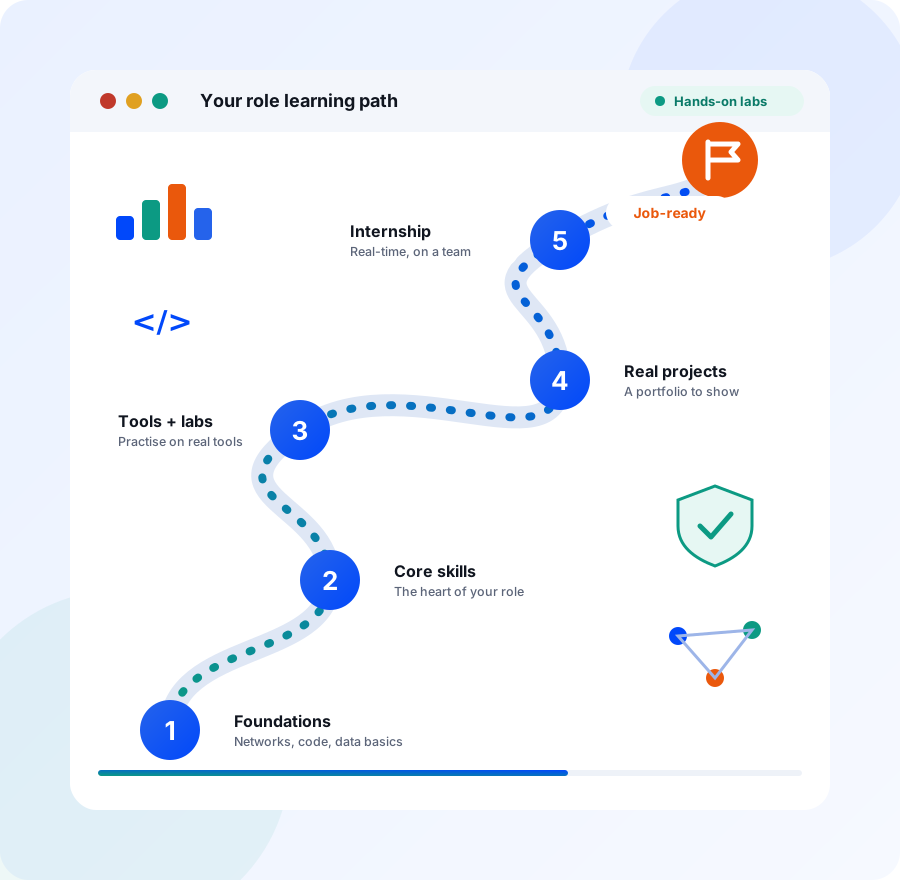
What a MLOps Engineer does
An MLOps engineer makes sure machine learning models and AI applications can be released, repeated and trusted. Data scientists and AI engineers create the models; you build the road they travel on: the pipeline that tests a change, the container that packages it, the registry that records which version is live and the monitoring that says when it goes wrong. It is software delivery work with extra questions, such as whether a new model version is actually better.
Week to week, you might set up a GitHub Actions pipeline that runs tests and builds a Docker image, add MLflow tracking so every training run is recorded, and write a regression suite that fails when answer quality drops. You look at traces to find why a request was slow, check cost per request, tidy secrets and access rights, and prepare a rollback plan before a release rather than after a failure.
MLOps engineers work in product companies, IT services and platform teams, banks and insurers, health and retail firms, and any organisation that has moved past a first model and now has several in production. The role matters because failures in AI systems are often quiet: predictions drift, costs creep up or answers slowly get worse. Someone has to notice, and MLOps engineers are the people trained to.
What you will be able to do
- Containerise a service with Docker and deploy it through a GitHub Actions pipeline.
- Track experiments and register models and prompts with MLflow-based versioning.
- Build a regression test suite that catches quality drops in an AI or RAG system.
- Add tracing and observability so the behaviour of a deployed system can be inspected.
- Set up cloud access rights and secrets, and describe a scaling and rollback plan.
- Explain how a model moves from training to serving to monitoring in a real team.
- Present an operationalised AI project, with its pipeline and monitoring, as a portfolio piece.
Who this course is for
IT support or system administrator
You already know Linux, servers and incident handling. This path adds Python, Docker, pipelines and model tracking, so you can move from keeping machines running to keeping AI systems running.
Final-year B.Tech or BCA student
Operations roles are easier to enter with hands-on proof. A project showing a tested, containerised, monitored AI service on GitHub can set you apart from candidates with only theory.
Non-IT graduate switching careers
Start with Python, Git and Linux basics, then build gradually. Be ready for many tools and steady practice, since operations work rewards careful habits more than quick tricks.
Software developer with deployment experience
You may already use Docker and pipelines. Spend your time on the AI-specific parts: model registry, evaluation as a release gate, drift, prompt versioning and cost and latency control.
What you will learn as a MLOps Engineer
These are the AI / ML programme modules that matter most for this role, in the order that suits it. Every topic, tool and lab below is part of the programme syllabus.
Python Backend Development with AI
Module 2 · 40 HrsOperations starts with delivery. Concentrate on testing, Docker, CI/CD with GitHub Actions and cloud deployment basics, because every MLOps pipeline you build later reuses these pieces.
See the full module →What you study
- Advanced Python and modular application architecture
- FastAPI development and RESTful API design
- Redis and background job queues
- Testing and test-driven development
- Docker containerization
- CI/CD with GitHub Actions
- Cloud deployment fundamentals
Tools you use
DockerGitHub ActionsPytestAWSAzureHands-on lab
Containerize a backend service with Docker and automate testing with GitHub Actions.
Machine Learning Engineering
Module 3 · 40 HrsYou cannot operate what you do not understand. Learn how models are trained, evaluated, packaged and monitored, and focus on pipelines, serving, retraining and experiment tracking with MLflow.
See the full module →What you study
- Machine learning fundamentals
- Model training and evaluation
- Building ML pipelines
- Deep learning fundamentals
- Model serving and deployment
- Model monitoring and retraining
Tools you use
MLflowScikit-learnFastAPIDockerHands-on lab
Track experiments and register models using MLflow, and set up monitoring for a deployed model.
MLOps, LLMOps & AI Platform Engineering
Module 6 · 30 HrsThis module is the centre of the role. Work through registry, versioning, regression tests, CI/CD for AI, tracing, IAM and secrets, and rollbacks, and treat evaluation as a gate a release must pass.
See the full module →What you study
- Experiment tracking and model registry
- Model and prompt versioning
- Regression testing for AI systems
- CI/CD for AI systems
- Tracing and observability
- Cloud IAM and secrets management
- Scaling and rollbacks
Tools you use
MLflowGitHub ActionsDockerCloud PlatformMonitoring ToolsHands-on project
AI Platform Operationalization. Apply MLOps/LLMOps practices — versioning, CI/CD, observability — to an existing AI service from the program.
Agentic AI Engineering
Module 5 · 40 HrsAgent systems fail in new ways. Concentrate on evaluation, observability, retries, fallbacks and guardrails, so you can monitor and harden AI systems that make several calls per request.
See the full module →What you study
- State and memory management
- Routing and agent workflows
- Human-in-the-loop design
- Retries, fallbacks and guardrails
- Agent evaluation and observability
- Prompt injection defence
Tools you use
LangGraphLLM APIsFastAPIDockerHands-on lab
Evaluate agent performance and add observability for monitoring agent behaviour.
Python & Technical Foundations
Module 1 · 30 HrsLinux and Git are your daily working environment. Use this module to become fast with the command line, virtual environments, Git workflows and debugging, and to write clear technical documentation.
See the full module →What you study
- Virtual environments and dependency management
- Git and GitHub version control workflows
- Linux and command-line interface fluency
- HTTP fundamentals and REST APIs
- Debugging techniques for Python applications
- Writing clear technical documentation
Tools you use
LinuxGitGitHubPythonHands-on lab
Set up and manage isolated virtual environments for a multi-project workflow.
What the programme covers for this role. The programme teaches MLOps and LLMOps as practical habits: pipelines, tracking, testing, tracing and safe releases on a cloud platform. It does not cover Kubernetes, infrastructure as code or large-scale data engineering, which teams often add on the job.
Where a MLOps Engineer course can take you
Junior MLOps Engineer or Backend Developer
The programme lists MLOps Engineer, LLMOps Engineer, AI Platform Engineer and AI Infrastructure Engineer for this area. The machine learning module also names MLOps Engineer as a foundation track, and many people start as junior backend developers.
MLOps Engineer or LLMOps Engineer
With experience you own pipelines, registries and monitoring for a team's models, and you decide how changes are tested and released across several projects at once.
AI Platform or AI Infrastructure Engineer
Engineers who enjoy shared tooling move toward platform work, building the common systems that let many teams train, deploy and observe models without repeating the setup each time.
Broader engineering leadership
From there, some become technical leads or move toward AI Solutions Engineer work. Placement assistance during the course includes resume, GitHub and LinkedIn help and mock interviews on your operational projects.
Certifications the programme prepares you for
- AWS ML Engineer / Cloud Practitioner
- Google Cloud Professional ML Engineer
- Microsoft Azure AI Engineer
- Databricks ML / GenAI Engineer
MLOps Engineer course, quick answers
What does an MLOps engineer do?
An MLOps engineer builds the systems that test, package, deploy and monitor machine learning models and AI applications. They track versions, automate releases, watch quality and cost, and make sure a bad release can be rolled back quickly.
Is MLOps the same as DevOps?
They share tools such as Docker, Git and CI/CD, but MLOps adds model-specific work: tracking experiments, versioning models and prompts, testing answer quality and monitoring drift. A DevOps background helps, while the AI-specific parts are new for most people.
Do I need to know machine learning to become an MLOps engineer?
You need to understand how a model is trained, evaluated and served, but not to invent new algorithms. The course covers that in its machine learning module before moving on to operations, so you can learn both in order.
Which tools will I use in this MLOps course?
You work with Docker, GitHub Actions, MLflow, Pytest, FastAPI and a cloud platform, plus monitoring tools for tracing and observability. Every tool appears in a lab, so you practise running it rather than only reading about it.
Can a fresher become an MLOps engineer directly?
It is a harder entry point than a junior backend or Python role, and many people start there and grow into MLOps. The course helps by giving you an operationalised AI project to show, but it cannot promise any particular first job.
Get the MLOps Engineer Course Fee Structure & Syllabus
Share your details and our admissions team will call you back with the full syllabus, batch timings and fee breakdown.
Read before you decide
Other roles in the AI / ML programme
Part of the Advanced AI & ML Certification Program
Every role course follows the same AI / ML programme, with the same modules, labs, projects and internship. See the full syllabus and every module.