
AI Solutions Engineer
Course in Hyderabad
A role-focused path through the AI & ML Certification Program
This role course arranges the AI and ML programme around an AI solutions engineer, who turns a client's problem into a working AI system. You build the technical base first, then focus on discovery, architecture, integration, security and the demonstrations that win client trust.
- Requirement gathering
- Workflow mapping
- AI solution architecture
- API integration
- PII and security handling
- Prototyping with FastAPI
- UAT and deployment
- Client demonstrations
Same duration and fees as the AI / ML programme.
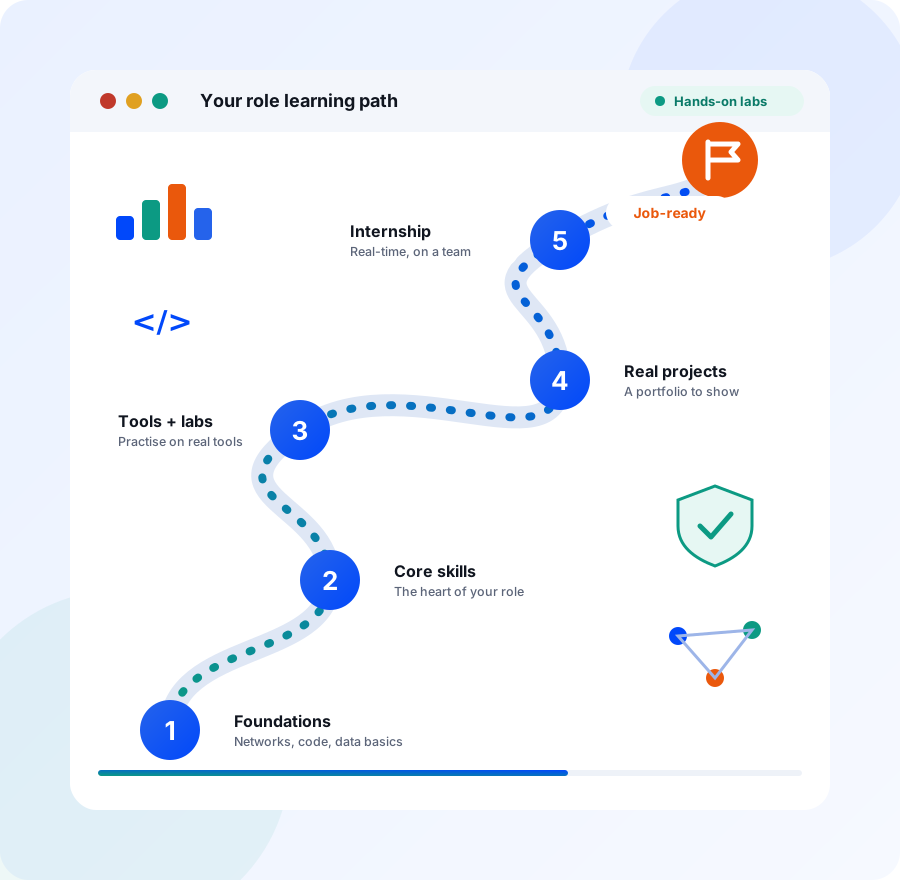
What a AI Solutions Engineer does
An AI solutions engineer sits between a client's business problem and the technical team that builds the answer. You listen to how the client's work runs today, decide where an AI system would help and where it would not, and design something that fits their data and tools. You still build: prototypes, integrations and demos. The difference from a pure engineer is that you are also responsible for scope, cost and whether the client can use the result.
In a typical week you might run a discovery call, map the client's workflow on a page and draw an architecture that shows where the model, the database and their existing systems connect. You then build a prototype with FastAPI and an LLM API, check how personal data is handled, and prepare a demo. Later come user acceptance testing, fixes from feedback, cost estimates and written documentation the client can keep.
AI solutions engineers work in IT services and consulting firms, product companies with client-facing teams, startups that sell AI features, and internal innovation teams at banks, hospitals and retailers. The role matters because many AI projects fail on scope and integration, not on the model. Teams need people who can ask the right questions early, explain trade-offs plainly and still build something that works.
What you will be able to do
- Run a client discovery session and turn what you hear into a clear workflow map.
- Design an AI solution architecture that shows data, system and API integration.
- Build a prototype that handles security and personal data with care.
- Run user acceptance testing on a prototype and prepare it for deployment.
- Produce architecture diagrams, technical documentation and a cost estimate for a solution.
- Explain a technical design to a non-technical client in plain language.
- Deliver a live demonstration of an end-to-end AI solution as a capstone project.
Who this course is for
Final-year student with good communication skills
If you enjoy talking to people as well as coding, this role suits you. Build the technical base carefully, and use the capstone to show you can scope, build and present a solution.
Business analyst or functional consultant
You already gather requirements and map processes. This path adds the technical side: Python, APIs, databases and language model applications, so you can design AI solutions and build prototypes yourself.
Non-IT graduate from sales, operations or support
Your knowledge of how businesses run is an asset. Start with Python and APIs, then use workflows from your earlier field as the problems your projects solve.
Working developer moving toward client-facing work
You can already code. Spend extra effort on discovery, architecture diagrams, cost estimates and presenting, which are usually the gaps for developers stepping into solution roles.
What you will learn as a AI Solutions Engineer
These are the AI / ML programme modules that matter most for this role, in the order that suits it. Every topic, tool and lab below is part of the programme syllabus.
Python Backend Development with AI
Module 2 · 40 HrsSolutions rest on working APIs and data stores. Concentrate on FastAPI design, PostgreSQL, authentication and access control and cloud deployment, since your prototypes and integrations depend on them.
See the full module →What you study
- FastAPI development and RESTful API design
- PostgreSQL and MongoDB database fundamentals
- Authentication, authorization and JWT / OAuth
- API security and role-based access control
- Docker containerization
- Cloud deployment fundamentals
Tools you use
FastAPIPostgreSQLDockerAWSHands-on lab
Deploy a production-style backend service to a cloud platform.
Generative AI & LLM Application Engineering
Module 4 · 40 HrsMost client requests today involve documents and language models. Learn LLM APIs, structured outputs, embeddings and RAG well enough to judge what is feasible and to prototype it quickly.
See the full module →What you study
- Large language models
- LLM APIs and prompt engineering
- Structured outputs and function calling
- Embeddings and vector databases
- Retrieval-Augmented Generation (RAG)
- Reranking and RAG evaluation
Tools you use
LLM APIspgvectorLangChainFastAPIHands-on project
Generative AI / RAG Application. Build LLM-powered apps with RAG, vector search and document understanding.
Agentic AI Engineering
Module 5 · 40 HrsClients also ask for assistants that act. Focus on tool calling, MCP, human-in-the-loop design and guardrails, so you can explain honestly what an agent can safely do inside a business process.
See the full module →What you study
- AI agent fundamentals and architecture
- Tool calling and function calling
- Model Context Protocol (MCP)
- Multi-agent patterns
- Human-in-the-loop design
- Retries, fallbacks and guardrails
Tools you use
LangGraphMCPLLM APIsPostgreSQLHands-on lab
Implement multi-step agent workflows with routing and human-in-the-loop checkpoints.
AI Solutions Engineering
Module 7 · 40 HrsThis module is the centre of the role. Give it the most time: discovery, workflow mapping, architecture, integration, PII handling, UAT, cost estimation, documentation and client demonstrations.
See the full module →What you study
- Client discovery and requirement gathering
- Workflow mapping
- AI solution architecture
- Data and system integration
- Security and PII handling
- UAT and deployment
- Architecture diagrams and client demonstrations
Tools you use
PythonFastAPIREST APIsCloud PlatformGitHubHands-on project
End-to-End AI Solution (Capstone). Design and build a complete AI solution from requirements to deployment and live demonstration.
MLOps, LLMOps & AI Platform Engineering
Module 6 · 30 HrsClients care about running cost, security and reliability. Concentrate on evaluation, cost and latency management, cloud access rights, and AI security, so your designs include the operating plan.
See the full module →What you study
- AI and RAG evaluation
- CI/CD for AI systems
- Cloud IAM and secrets management
- Scaling and rollbacks
- Cost and latency management
- AI security and reliability
Tools you use
MLflowGitHub ActionsCloud PlatformMonitoring ToolsHands-on lab
Manage cloud IAM, secrets, scaling and rollback strategy for a deployed AI platform.
What the programme covers for this role. The programme teaches solution delivery as part of an AI engineering course: discovery, architecture, integration, UAT and demos. It is not a full consulting or pre-sales programme, so sales skills and industry domain knowledge are built through practice on the job.
Where a AI Solutions Engineer course can take you
AI Implementation or AI Integration Engineer
The programme lists AI Solutions Engineer, AI Integration Engineer, AI Implementation Engineer and AI Consultant for this module. Entry roles often focus on building integrations and prototypes under a senior solutions lead.
AI Solutions Engineer
With a few delivered projects you run discovery yourself, design architectures and present to clients, while your build skills keep your designs realistic and easy to defend.
AI Consultant
Some move into consulting, advising several clients on where AI fits and how to adopt it, using documentation, cost estimates and demos as their main working tools.
Technical leadership
Later paths include AI Engineer leads and platform roles. Placement assistance during the course includes resume, GitHub and LinkedIn help and mock interviews that use your capstone as the main story.
Certifications the programme prepares you for
- Microsoft Azure AI Engineer
- AWS ML Engineer / Cloud Practitioner
- IBM AI / Generative AI Engineering
AI Solutions Engineer course, quick answers
What does an AI solutions engineer do?
An AI solutions engineer works with clients to understand a business problem, design an AI system that fits it, build a prototype and see it through testing and deployment. The role mixes technical building with discovery, documentation and presenting.
Is an AI solutions engineer a technical or a client-facing role?
Both. You still write code and connect systems, but you also speak with clients, map workflows and explain designs. Teams differ in how much of each they expect, so this course trains both sides together.
Do I need to code to become an AI solutions engineer?
Yes, at a working level. You need Python, APIs, databases and some language model work to build prototypes and judge what is feasible. The course teaches these from the basics before it moves to design and delivery.
What is the difference between an AI solutions engineer and an AI engineer?
An AI engineer mostly builds and runs the system inside a team. An AI solutions engineer also scopes the problem with the client, designs the architecture, estimates cost and demonstrates the result. There is overlap, and many people move between the two.
What project will I show for an AI solutions engineer role?
You build an end-to-end AI solution as a capstone: requirements, workflow map, architecture, a working prototype, testing, documentation and a live demonstration. It is the closest thing in the course to a small client engagement.
Get the AI Solutions Engineer Course Fee Structure & Syllabus
Share your details and our admissions team will call you back with the full syllabus, batch timings and fee breakdown.
Read before you decide
Other roles in the AI / ML programme
Part of the Advanced AI & ML Certification Program
Every role course follows the same AI / ML programme, with the same modules, labs, projects and internship. See the full syllabus and every module.