
Backend Developer
Course in Hyderabad
A role-focused path through the AI & ML Certification Program
This role course arranges the AI and ML programme around a Python backend developer who builds AI-ready services. You learn Python, FastAPI, databases, security and deployment first, then add the language model, testing and release skills that modern backend teams now expect.
- Python programming
- FastAPI development
- REST API design
- PostgreSQL and MongoDB
- Redis job queues
- JWT authentication
- Docker and CI/CD
- Pytest testing
Same duration and fees as the AI / ML programme.
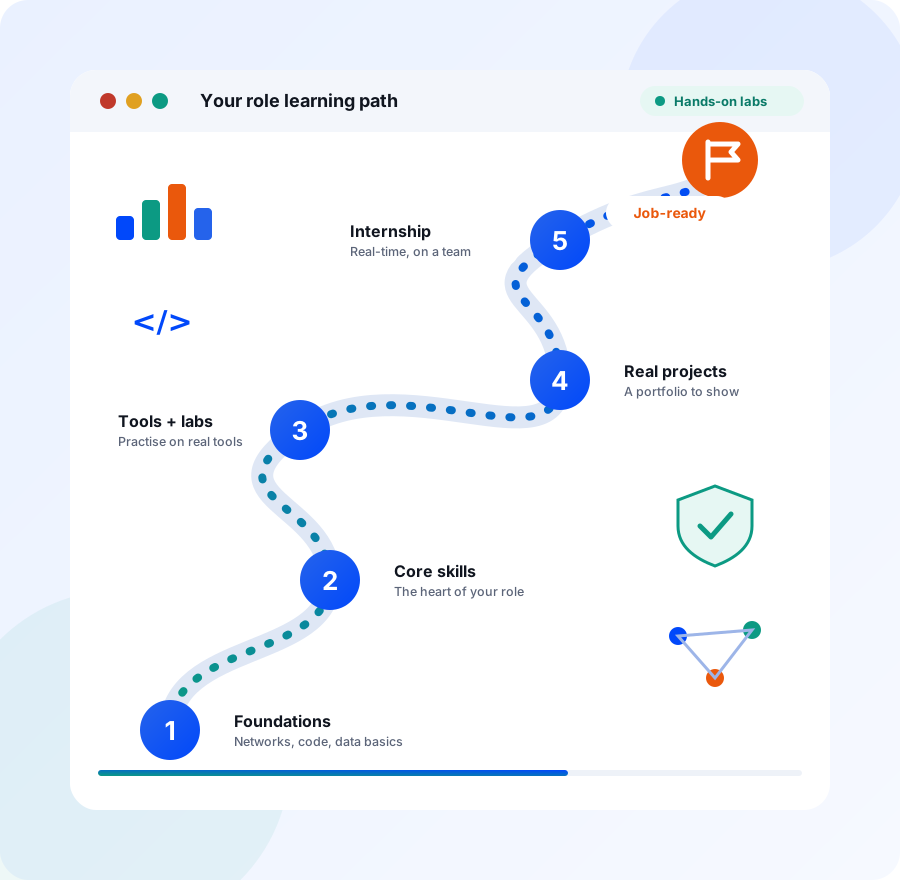
What a Backend Developer does
A backend developer builds the part of an application that users never see but everything depends on: the APIs, the databases, the login system and the background jobs. In this course the path is Python and FastAPI, so you learn how a request travels from an app to a service, into a database and back. The AI angle is that the same skills carry the services that serve models and language model features.
Week to week, a backend developer designs an endpoint, writes it, tests it and ships it. You might add a table in PostgreSQL, protect a route with role-based access, move a slow task onto a Redis queue, or package a service in Docker so it runs the same everywhere. Reviews, bug fixes and small releases fill the rest of the time, along with reading other people's code and improving it.
Backend developers work in software product companies, IT services firms, startups, e-commerce, banking and fintech teams, and increasingly in teams building AI products, where every model needs a reliable service around it. The role matters because users judge an application by whether it is fast, correct and safe. That depends on backend work being tested, secured and easy to maintain.
What you will be able to do
- Build a RESTful API with FastAPI backed by PostgreSQL and describe its design choices.
- Implement authentication and role-based access control with JWT to protect each route of an API.
- Add background job processing to a service using Redis-backed queues.
- Write automated tests with Pytest and set up a GitHub Actions pipeline.
- Package a service with Docker and deploy it to a cloud platform.
- Serve a language model feature through your own API using structured outputs and pgvector.
- Show a documented, tested backend project on GitHub in an interview.
Who this course is for
Final-year B.Tech or BCA student
Backend skills are among the easiest to prove with projects. Finish the course with a secured, tested API deployed in the cloud, and you have something to walk an interviewer through.
IT support or testing engineer
You know how software breaks. This path teaches you to build the services yourself, with Python, databases and pipelines, so your testing mindset becomes part of your code.
Non-IT graduate switching careers
Python is a friendly first language, and the course starts from the basics. Expect several months of steady coding practice, and finish with a working API rather than only exercises.
Developer in another language
If you code in another language, you can move quickly through syntax. Spend your time on FastAPI, Redis queues, JWT login and the AI serving patterns that are new to you.
What you will learn as a Backend Developer
These are the AI / ML programme modules that matter most for this role, in the order that suits it. Every topic, tool and lab below is part of the programme syllabus.
Python & Technical Foundations
Module 1 · 30 HrsEverything else stands on this. Concentrate on Python, functions and classes, error handling, virtual environments, Git, HTTP and REST, JSON and basic tests, and set up a GitHub portfolio early.
See the full module →What you study
- Python programming fundamentals — syntax, data structures and control flow
- Functions and object-oriented programming in Python
- Error handling and writing resilient code
- Virtual environments and dependency management
- Git and GitHub version control workflows
- HTTP fundamentals and REST APIs
- Basic automated testing
Tools you use
PythonGitGitHubPostmanREST APIsHands-on lab
Call and test REST APIs using Postman, and parse JSON responses in Python.
Python Backend Development with AI
Module 2 · 40 HrsThis is the heart of the role. Give it your full effort: FastAPI design, both database types, Redis queues, JWT and access control, testing, Docker, CI/CD and cloud deployment, ending with the backend project.
See the full module →What you study
- Advanced Python and modular application architecture
- FastAPI development and RESTful API design
- PostgreSQL and MongoDB database fundamentals
- Redis and background job queues
- Authentication, authorization and JWT / OAuth
- API security and role-based access control
- Testing and test-driven development
Tools you use
FastAPIPostgreSQLMongoDBRedisPytestHands-on project
Backend API Service. Build and deploy a secure, production-style REST API with FastAPI, PostgreSQL/MongoDB, authentication and Docker.
Generative AI & LLM Application Engineering
Module 4 · 40 HrsBackend teams now add language model features. Concentrate on calling LLM APIs, structured outputs, function calling, and pgvector search inside PostgreSQL, since these fit naturally into services you can already build.
See the full module →What you study
- LLM APIs and prompt engineering
- Structured outputs and function calling
- Embeddings and vector databases
- Document ingestion and chunking
- Retrieval-Augmented Generation (RAG)
- PostgreSQL and pgvector
Tools you use
LLM APIsPostgreSQLpgvectorFastAPIHands-on lab
Generate and store embeddings in a vector database using pgvector.
MLOps, LLMOps & AI Platform Engineering
Module 6 · 30 HrsBackend work does not end at release. Focus on CI/CD, regression tests, tracing, cloud IAM and secrets, scaling and rollbacks, which are the habits that keep a service dependable.
See the full module →What you study
- Regression testing for AI systems
- CI/CD for AI systems
- Tracing and observability
- Cloud IAM and secrets management
- Scaling and rollbacks
- Cost and latency management
Tools you use
GitHub ActionsDockerCloud PlatformMonitoring ToolsHands-on lab
Set up a CI/CD pipeline that tests and deploys an AI system automatically.
AI Solutions Engineering
Module 7 · 40 HrsReal services connect to other systems and hold private data. Use this module for API and system integration, security and PII handling, UAT, and writing documentation your team can follow.
See the full module →What you study
- Data and system integration
- API integration
- Security and PII handling
- Solution design and prototyping
- UAT and deployment
- Cost estimation and technical documentation
Tools you use
PythonFastAPIREST APIsPostgreSQLDockerHands-on lab
Run UAT on a prototyped solution and prepare it for deployment.
What the programme covers for this role. This role course covers Python backend and AI-application backend work: FastAPI, databases, security, queues and deployment. It does not teach Java, Node.js, Go, Kubernetes or message brokers such as Kafka, so those would be separate learning for teams that use them.
Where a Backend Developer course can take you
Junior Backend Developer or Python Developer
The first module names Python Developer (Trainee), Backend Developer (Junior) and Software Engineer (Trainee) as entry roles. These teams usually pair you with a senior developer on real tickets.
Backend Developer or API Developer
With a year or two of experience you own services and APIs end to end: design, tests, release and support, and you become the person others ask about the database or the auth flow.
Software Engineer with AI focus
Backend developers who add language model and machine learning skills move toward AI Engineer, Generative AI Engineer or Machine Learning Engineer roles, since they already know how to ship services.
Platform and leadership roles
Others lean toward MLOps Engineer, AI Platform Engineer or technical lead work. Placement assistance during the course includes resume, GitHub and LinkedIn help and mock interviews on your backend project.
Certifications the programme prepares you for
- AWS ML Engineer / Cloud Practitioner
- Microsoft Azure AI Engineer
- Oracle Cloud Infrastructure AI
Backend Developer course, quick answers
Which language does this backend developer course use?
Python. You start with Python fundamentals, then build APIs with FastAPI and write tests with Pytest. If you later need Java or Node.js, the concepts of APIs, databases and security carry across, but those languages are not taught here.
Do I need coding experience to join a Python backend developer course?
No. The first module starts with Python syntax, data structures, Git and Linux, so beginners can begin there. What you do need is time for daily coding practice, since backend skill comes from writing and fixing real code.
What databases will I learn as a backend developer?
You learn PostgreSQL for structured data and MongoDB for flexible documents, plus Redis for caching and background job queues. You also see pgvector, which lets PostgreSQL store embeddings for search in AI features.
How is an AI-focused backend course different from a normal backend course?
The backend core is the same: APIs, databases, login, tests and deployment. The difference is that you also learn to serve models and language model features through those APIs, which many current backend job descriptions now mention.
Can I become a backend developer without learning machine learning?
Yes. Modules one and two alone cover a full Python backend path, and the later modules are optional strengths. Still, many teams now build AI features, so knowing how to serve them can widen the roles you can apply for.
Get the Backend Developer Course Fee Structure & Syllabus
Share your details and our admissions team will call you back with the full syllabus, batch timings and fee breakdown.
Read before you decide
Other roles in the AI / ML programme
Part of the Advanced AI & ML Certification Program
Every role course follows the same AI / ML programme, with the same modules, labs, projects and internship. See the full syllabus and every module.