AI Engineer
Course in Hyderabad
A role-focused path through the AI & ML Certification Program
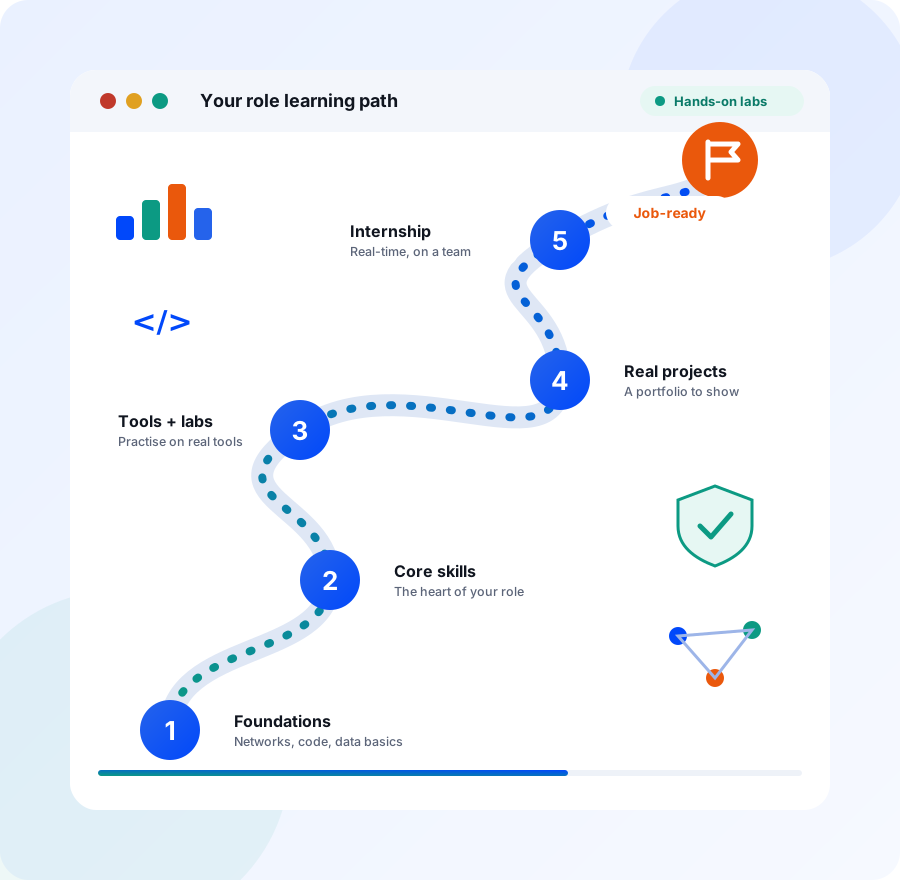
This role course arranges the AI and ML programme around the work of an AI engineer, who builds software that uses models and keeps it running. You begin with Python and backend skills, then add machine learning, language model applications, agents and production habits, with a lab or project at every step.
- Python development
- FastAPI services
- Machine learning models
- LLM API integration
- RAG applications
- AI agents with LangGraph
- Docker packaging
- Testing and monitoring
Same duration and fees as the AI / ML programme.
What a AI Engineer does
An AI engineer builds products that use models. The model may be a classifier you trained yourself or a language model you reach through an API, but the job is the software wrapped around it: the service that takes a request, the data it needs, the checks on the answer and the release that puts it in front of users. It sits between the data scientist who studies the data and the backend developer who builds the service, and it needs a working knowledge of both.
Week to week, an AI engineer takes a request such as "answer customer questions from our documents" and turns it into something testable. That means reading the problem with the team, choosing an approach, building a first version, wrapping it in an API and measuring how often it is right. Then comes the slower part: fixing weak answers, adding tests, watching cost and response time, and shipping small improvements instead of one big rewrite.
People in this role work in software product companies, IT services firms, startups, banks, hospitals, retail and logistics teams, and anywhere a business wants an AI feature that real users can rely on. It matters because a model that only runs in a notebook helps nobody. Companies need engineers who can connect it to data, protect it, test it and keep it working after launch, and that is the gap this course trains you to fill.
What you will be able to do
- Write clean Python programs and manage a project with Git, GitHub and virtual environments.
- Build and secure a FastAPI service backed by PostgreSQL and deploy it in a container.
- Train, evaluate and serve a machine learning model as a working API endpoint.
- Build a retrieval-augmented generation app that answers questions from a real document set.
- Create a tool-using agent with LangGraph that includes memory and human checkpoints.
- Set up tests, tracing and a CI/CD pipeline that catch quality drops before release.
- Explain your design choices in an interview using projects you have built and documented.
Who this course is for
Final-year B.Tech, BCA or B.Sc student
You have time to build the foundation properly. Use the course to arrive at campus hiring with deployed projects on GitHub, not only a degree, and to show you can ship software as well as write it.
IT support or testing engineer
You already know how systems fail and how to read logs. This path adds Python services, machine learning and language model applications, so your existing habits become an advantage in an engineering team.
Non-IT graduate switching careers
You can start from Python basics, since the first module assumes no AI background. Expect steady weekly practice, and use your earlier field for project ideas that feel real to an interviewer.
Working developer adding AI skills
If you already write code, move quickly through the foundations and spend your time on the machine learning, language model and agent modules, where the new patterns and the most practice sit.
What you will learn as a AI Engineer
These are the AI / ML programme modules that matter most for this role, in the order that suits it. Every topic, tool and lab below is part of the programme syllabus.
Python & Technical Foundations
Module 1 · 30 HrsAn AI engineer is a software engineer first. Concentrate on clean Python, Git habits, REST and JSON, and basic tests, because every later project in this path builds on them.
See the full module →What you study
- Python programming fundamentals — syntax, data structures and control flow
- Functions and object-oriented programming in Python
- Virtual environments and dependency management
- Git and GitHub version control workflows
- HTTP fundamentals and REST APIs
- Basic automated testing
Tools you use
PythonGitGitHubPostmanHands-on lab
Call and test REST APIs using Postman, and parse JSON responses in Python.
Python Backend Development with AI
Module 2 · 40 HrsThis is where you learn to make a service other software can depend on. Focus on FastAPI design, a relational database, login and access control, and getting a container running in the cloud.
See the full module →What you study
- FastAPI development and RESTful API design
- PostgreSQL and MongoDB database fundamentals
- Authentication, authorization and JWT / OAuth
- Testing and test-driven development
- Docker containerization
- CI/CD with GitHub Actions
Tools you use
FastAPIPostgreSQLDockerPytestHands-on project
Backend API Service. Build and deploy a secure, production-style REST API with FastAPI, PostgreSQL/MongoDB, authentication and Docker.
Machine Learning Engineering
Module 3 · 40 HrsLearn enough machine learning to choose and judge a model, not just call one. Concentrate on evaluation, pipelines and serving a trained model behind an endpoint you built earlier.
See the full module →What you study
- Machine learning fundamentals
- Supervised learning techniques
- Model training and evaluation
- Building ML pipelines
- Model serving and deployment
- Model monitoring and retraining
Tools you use
Scikit-learnPandasFastAPIMLflowHands-on lab
Serve a trained model as a FastAPI endpoint and containerize it with Docker.
Generative AI & LLM Application Engineering
Module 4 · 40 HrsLanguage models are now a core building block. Focus on prompts, structured outputs, embeddings and a full retrieval pipeline, and on judging answers instead of trusting them.
See the full module →What you study
- LLM APIs and prompt engineering
- Structured outputs and function calling
- Embeddings and vector databases
- Document ingestion and chunking
- Retrieval-Augmented Generation (RAG)
- Reranking and RAG evaluation
Tools you use
LLM APIsLangChainpgvectorFastAPIHands-on project
Generative AI / RAG Application. Build LLM-powered apps with RAG, vector search and document understanding.
Agentic AI Engineering
Module 5 · 40 HrsAgents extend an application from answering to acting. Concentrate on tool calling, state, human approval steps and guardrails, since safe behaviour matters more than clever behaviour.
See the full module →What you study
- AI agent fundamentals and architecture
- Tool calling and function calling
- State and memory management
- Human-in-the-loop design
- Retries, fallbacks and guardrails
- Prompt injection defence
Tools you use
LangGraphLLM APIsMCPFastAPIHands-on lab
Add retries, fallbacks and guardrails to make an agent reliable in production.
MLOps, LLMOps & AI Platform Engineering
Module 6 · 30 HrsShipping is only half the job. Focus on regression tests for AI behaviour, CI/CD, tracing and cost and latency checks, so you can keep a system reliable after release.
See the full module →What you study
- AI and RAG evaluation
- Regression testing for AI systems
- CI/CD for AI systems
- Tracing and observability
- Cost and latency management
- AI security and reliability
Tools you use
MLflowGitHub ActionsDockerMonitoring ToolsHands-on lab
Build a regression test suite for an AI/RAG system to catch quality drops before release.
Where a AI Engineer course can take you
AI Engineer (junior) or Python Developer
Most people start in a junior AI engineer, Python developer or backend role, where you build and maintain services with a senior colleague. Module roles also list Software Engineer and Machine Learning Developer as entry titles.
AI Engineer with a specialism
After some experience you can lean toward a track from the programme: Machine Learning Engineer, Generative AI Engineer or Agentic AI Engineer, depending on which type of problem you enjoy most.
Production and platform roles
Engineers who like reliability move toward MLOps Engineer, LLMOps Engineer or AI Platform Engineer, owning how AI systems are versioned, deployed and monitored across a whole team.
Solutions and leadership
Others move toward AI Solutions Engineer or AI Consultant work, scoping projects with clients, and in time to technical lead roles. Placement assistance during the course covers resume, GitHub and LinkedIn help and mock interviews.
Certifications the programme prepares you for
- Microsoft Azure AI Engineer
- AWS ML Engineer / Cloud Practitioner
- NVIDIA Generative AI & LLMs
- IBM AI / Generative AI Engineering
AI Engineer course, quick answers
What does an AI engineer do compared with a data scientist?
A data scientist studies data and builds predictions. An AI engineer builds the working product around a model: the API, the data flow, the tests and the deployment. There is overlap, but this course leans toward building and shipping software.
Do I need to know coding before joining an AI engineer course?
No, but you will code a lot. The first module teaches Python, Git and Linux from the ground up, so a beginner can start there. Regular practice each week matters more than prior experience.
Is maths important for becoming an AI engineer?
Basic comfort with numbers and logic helps, and you meet ideas such as evaluation metrics and vectors while working with real data. Most of the daily work is software engineering, so you do not need advanced maths to begin.
Which projects will I build for an AI engineer portfolio?
You build a Python application, a secure backend API, a machine learning service, a retrieval-augmented generation app, an agent application and an operationalised AI service. Each is documented on GitHub so an interviewer can read how you built it.
Can a fresher get an AI engineer job in Hyderabad?
Freshers do get hired into junior AI and Python roles, but no course can promise a job. The programme gives you projects, an internship phase and placement assistance, and your GitHub work and interview practice decide the rest.
Get the AI Engineer Course Fee Structure & Syllabus
Share your details and our admissions team will call you back with the full syllabus, batch timings and fee breakdown.
Read before you decide
Other roles in the AI / ML programme
Part of the Advanced AI & ML Certification Program
Every role course follows the same AI / ML programme, with the same modules, labs, projects and internship. See the full syllabus and every module.