
Incident Response Analyst
Course in Hyderabad
A role-focused path through the Cyber Security Certification Program
This role course arranges the Cyber Security programme around incident response. You learn how systems are broken into and how malware behaves, then use that knowledge to contain an attack, clean up the affected machines, write the incident record and improve the defences afterwards.
- Incident response process
- Response playbooks
- Malware behaviour
- Packet analysis
- Windows privilege escalation
- Endpoint remediation
- Threat intelligence basics
- Incident reporting
Same duration and fees as the Cyber Security programme.
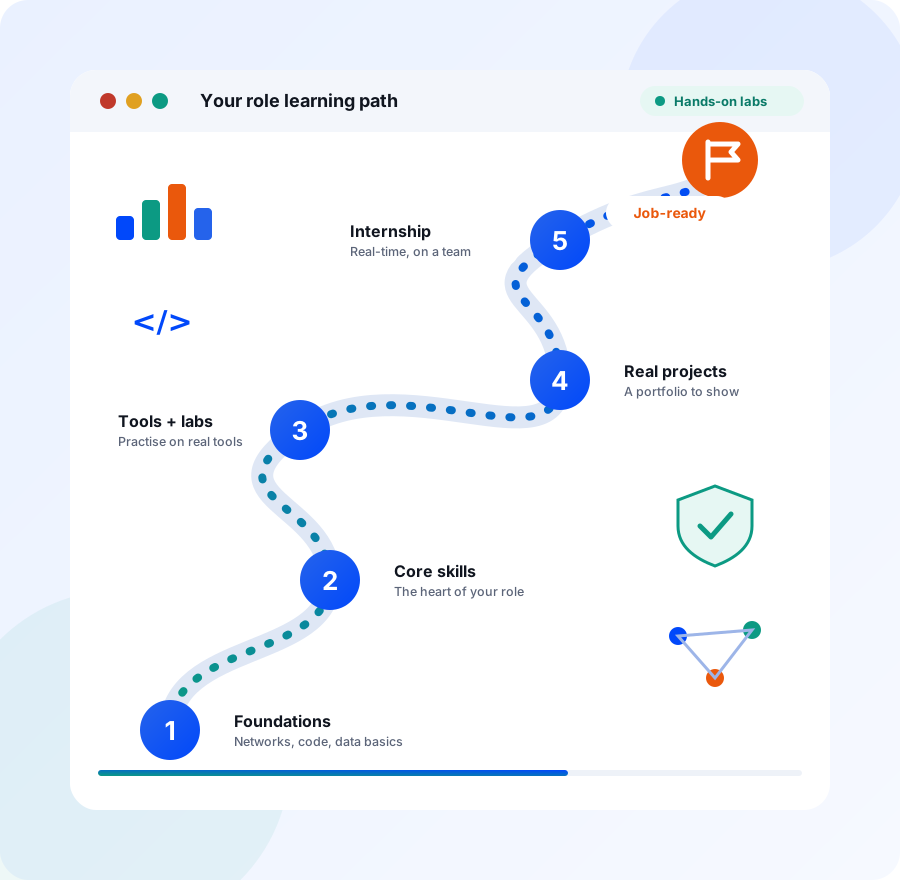
What a Incident Response Analyst does
An incident response analyst is called in when something has already gone wrong: a laptop infected with ransomware, an account used by a stranger, or a server sending out data it should not. The job is to work out what happened, stop it spreading, return the systems to a safe state and record everything. Speed matters, but calm and careful notes matter just as much.
In this course the role is built from the attacker's side first. You learn how privilege escalation, malware and social engineering work in a lab, so that when you read evidence you recognise the technique behind it. A typical case moves from an alert to packet and host checks, then to containment steps from a playbook, cleanup, and a written report with lessons for next time.
Incident response analysts work in security teams inside larger companies, in managed security and consulting firms that handle clients' incidents, and in risk and compliance teams that need clean incident records. The role matters because most organisations will face an incident at some point, and how well they respond decides how much damage follows. Analysts who understand attacks well often grow into malware analysis, threat intelligence and senior response work.
What you will be able to do
- Describe the incident response process from detection to containment, eradication and recovery.
- Build and run an incident response playbook against a simulated breach.
- Recognise privilege escalation and credential attacks and explain how they leave traces in evidence.
- Analyse controlled malware behaviour in a sandbox and classify what you see.
- Capture and analyse network traffic to identify a live attack pattern.
- Remove malware from a compromised host and apply endpoint hardening.
- Map an incident to the Cyber Kill Chain and explain each stage.
- Write a formal incident report and an executive summary for managers.
Who this course is for
Final-year student who likes investigating
You enjoy working out what happened and why. The course gives you the attack knowledge and a response process, so you can approach an incident with a plan instead of guesswork.
Desktop support or system administrator
You have already cleaned infected machines and reset compromised accounts. This path adds structure: a proper response process, a way to read network evidence and a way to write the case up.
Network engineer
You know how traffic should look, which helps you spot traffic that does not belong. The course adds attacker techniques, malware behaviour and the response playbook around what you already understand.
Career switcher from audit, operations or quality
Careful records, clear steps and calm under pressure carry over well from those jobs. You will need to learn the technical side, which the course builds from networking basics upwards.
What you will learn as a Incident Response Analyst
These are the Cyber Security programme modules that matter most for this role, in the order that suits it. Every topic, tool and lab below is part of the programme syllabus.
Cybersecurity & Ethical Hacking Foundations
Module 1 · 20 HrsResponse starts with knowing what normal looks like. Concentrate on networking, the Windows and Linux command lines, the Cyber Kill Chain and threat actor profiles, and how policy and compliance rules shape what you must report.
See the full module →What you study
- Types of hackers and threat actor profiles: white hat, grey hat, black hat, nation-state and insider threats
- Cyber Kill Chain concept and the stages of a typical attack lifecycle
- Networking fundamentals — the OSI model, the TCP/IP stack, ports and protocols
- 3-way and 2-way TCP handshakes, and the role of core networking devices
- Linux command-line essentials for security practitioners
- Windows command-line essentials and baseline system administration
- Cyber laws, compliance obligations and organisational security policy basics
Tools you use
Linux/Windows CLIKali LinuxVirtualBoxHands-on project
Threat Actor Profiling Brief. Profile a threat actor archetype relevant to a chosen industry vertical and its likely attack objectives.
System Hacking, Malware & Social Engineering
Module 3 · 30 HrsThe core module for this role. Work on privilege escalation, malware types, sandbox and packet analysis, malware remediation and incident documentation, because these are the cases you will actually be investigating.
See the full module →What you study
- Windows system hacking and privilege escalation techniques
- Windows login bypass and credential attack techniques
- Malware concepts, classification and types — virus, worm, trojan, ransomware, rootkit
- Packet analysis and network traffic inspection
- Endpoint hardening and malware remediation basics
- Incident documentation for system-compromise scenarios
Tools you use
WiresharkKali LinuxParrot SecurityNetcatHands-on lab
Analyse controlled malware behaviour inside an isolated sandbox.
AI-Powered Security Operations & Cyber Defense
Module 6 · 20 HrsHere the response process comes together. Learn detection, containment, eradication and recovery, build and run playbooks, read SIEM alerts, use threat intelligence, and finish with an executive-level report.
See the full module →What you study
- SIEM fundamentals — log collection, correlation and alerting
- Incident response process — detection, containment, eradication, recovery
- Automated incident response and SOC workflow orchestration
- Building and executing incident response playbooks
- Threat intelligence fundamentals and intelligence-led defence
- Professional security reporting and executive documentation
Tools you use
SIEM & Log PlatformsAI Threat-Detection PlatformsWiresharkNetcatHands-on lab
Build and execute an incident response playbook against a simulated breach.
Penetration Testing & Web Exploitation
Module 4 · 60 HrsResponders investigate attacks they did not carry out. Work through session hijacking, evasion of firewalls and IDS, web attack methods and Active Directory attacks so you know the tricks an attacker uses to stay hidden.
See the full module →What you study
- Session hijacking concepts and cookie-based attacks
- IDS, IPS, firewall and honeypot evasion techniques
- Web server and web application attack methodology
- SQL Injection — concepts, types and injection tooling
- Cross-Site Scripting (XSS) — reflected, stored and DOM-based
- Active Directory concepts and common AD attack techniques
Tools you use
WiresharkBurp SuiteCain & AbelNiktoHands-on lab
Simulate an Active Directory attack path inside a lab domain environment.
Reconnaissance, Scanning & Enumeration
Module 2 · 30 HrsFinish by learning how a weakness is scored and tracked. Concentrate on CVE, CVSS and CWE records, scanning and attack surface mapping, so you can tell which gap was used and which others are still open.
See the full module →What you study
- Passive vs active reconnaissance — when and how to use each
- Port scanning fundamentals and advanced scanning techniques (SYN, stealth, UDP)
- Vulnerability assessment using automated scanning tools
- Reading and scoring vulnerability records with CVE, CVSS and CWE
- Using the NIST and NVD vulnerability databases inside an assessment
- Building an attack-surface map from reconnaissance data
Tools you use
OpenVASNmapNetcatHands-on lab
Run an automated vulnerability scan with OpenVAS and triage results by CVSS score.
What the programme covers for this role. The programme covers the incident response process, playbooks, malware behaviour, packet analysis and incident reporting in a lab. It has no dedicated digital forensics or memory analysis module, so deeper evidence-handling skills are something to build after the course.
Where a Incident Response Analyst course can take you
Incident Response Analyst (Junior)
Entry titles include Incident Response Analyst (Junior), Junior Security Analyst and IT Security Analyst. You work cases with a senior colleague, follow playbooks and write the first drafts of incident reports.
Incident Response Analyst
With experience you lead cases from first alert to final report, improve the playbooks the team uses, and explain incidents to managers who need plain answers about what happened and what changes next.
Malware, threat intelligence or detection roles
Responders often specialise as a Malware Analyst, a Threat Intelligence Analyst or a Threat Detection Engineer, using what they learn from incidents to spot the next one earlier.
Longer term
Over time the path can lead to Security Consultant roles or to Security Automation Engineer work, where repeatable response steps are turned into automated workflows.
Certifications the programme prepares you for
- CompTIA Security+
- ISC2 Certified in Cybersecurity (CC)
- Microsoft Security Operations Analyst
Incident Response Analyst course, quick answers
What are the stages of incident response?
The programme teaches four core stages: detection, containment, eradication and recovery. Around them sit documentation and a review of what to improve. You practise the full flow by building a playbook and running it against a simulated breach.
Do I need to know malware analysis to work in incident response?
You need to recognise malware types such as viruses, worms, trojans, ransomware and rootkits, watch how they behave in a sandbox, and clean an infected host. The syllabus covers that at a practical level and does not go into deep reverse engineering.
What is an incident response playbook?
A playbook is a written set of steps for one type of incident, such as phishing or ransomware. It says who does what, in which order, and what to record. You build one and run it against a simulated breach in the course.
Can a fresher start in incident response?
Junior titles exist, and Incident Response Analyst (Junior) is one of the roles the programme lists. Hiring varies by company, so build your evidence with the playbook, incident report and lab projects, and use the placement assistance for resume and interview practice.
How is incident response different from penetration testing?
A penetration test attacks a system in a planned, permitted way to find weaknesses before an attacker does. Incident response begins after something has happened and focuses on containment, cleanup and records. Both need attack knowledge, and this programme teaches both sides.
Get the Incident Response Analyst Course Fee Structure & Syllabus
Share your details and our admissions team will call you back with the full syllabus, batch timings and fee breakdown.
Read before you decide
Other roles in the Cyber Security programme
Part of the Advanced Cyber Security Certification Program
Every role course follows the same Cyber Security programme, with the same modules, labs, projects and internship. See the full syllabus and every module.