
Ethical Hacker
Course in Hyderabad
A role-focused path through the Cyber Security Certification Program
This role course arranges the Cyber Security programme around the work of an ethical hacker. You learn how attackers think and work, then practise their techniques on systems you own, including malware, social engineering, passwords and wireless networks, always inside a lab with clear rules.
- Attacker mindset
- OSINT reconnaissance
- Privilege escalation
- Malware behaviour
- Social engineering
- Password cracking
- Wireless testing
- Kali Linux toolkit
Same duration and fees as the Cyber Security programme.
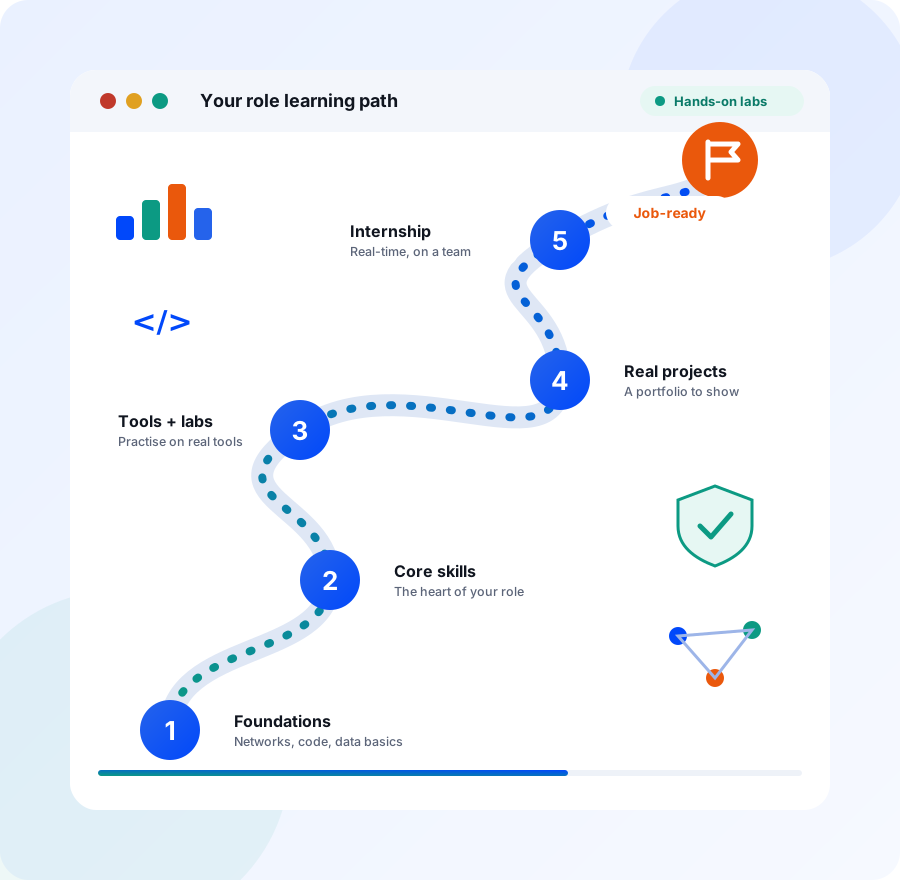
What a Ethical Hacker does
An ethical hacker uses the same techniques as a criminal attacker, but with permission and with the aim of making a system safer. The title covers a wide range of work: testing networks and applications, trying phishing on staff, checking passwords and wireless networks, and looking at devices and mobile apps. What holds it together is a habit of asking how something could be abused, and a strict respect for the limits you are given.
Week to week the work changes with the client. One week you might scan a small office network and check which services are exposed. The next you might design a phishing test, review how strong the company's passwords are, or examine an Android app. Each task ends the same way, with notes on what worked, what it proves and a plain recommendation. Reading about new attack methods is part of the routine.
Ethical hackers work in security consulting companies, in internal security teams, and in product companies that want their software checked before launch. Any organisation with customers, staff logins or connected devices can be a target, which is why the work is needed across banking, retail, healthcare and government. Many people begin here and later specialise in web testing, mobile security or red team work as their interests become clear.
What you will be able to do
- Explain how attackers think using the Cyber Kill Chain and different threat actor profiles.
- Build and run a safe, isolated hacking lab with Kali Linux and vulnerable targets.
- Perform reconnaissance and OSINT gathering, then scan and enumerate a lab network.
- Demonstrate privilege escalation on Windows and describe how to defend against it.
- Design a lab-safe social engineering test and recommend staff awareness steps.
- Crack password hashes with dictionary and brute-force methods and explain the weakness behind them.
- Test wireless networks and an Android app for common security weaknesses.
- Document findings and rules of engagement in a report that a client can act on.
Who this course is for
Curious final-year student
You have tried capture the flag puzzles or watched hacking videos and want proper structure. The course gives you the lab, the legal framework and the method behind what you have seen online.
Working system administrator
You know how servers and users are set up, so you know where shortcuts tend to hide. Here you learn to test those systems from the attacker's side and to report what you find without causing damage.
Non-IT graduate
A degree in another subject is fine. Begin with the foundations module, spend time on the command line, and repeat each lab until you can explain every step to someone else.
Career switcher with a security interest
Perhaps you work in support, testing or networking and want to move into security. The mix of attack and defence topics lets you find out which side suits you before you specialise.
What you will learn as a Ethical Hacker
These are the Cyber Security programme modules that matter most for this role, in the order that suits it. Every topic, tool and lab below is part of the programme syllabus.
Cybersecurity & Ethical Hacking Foundations
Module 1 · 20 HrsStart with how attackers are classified, how an attack unfolds and what the law allows. Build the lab carefully because every later exercise runs in it, and learn the rules of engagement before you learn any exploit.
See the full module →What you study
- Types of hackers and threat actor profiles: white hat, grey hat, black hat, nation-state and insider threats
- The CIA Triad and the core principles that every security control is designed to protect
- Cyber Kill Chain concept and the stages of a typical attack lifecycle
- Building a lab environment using VirtualBox, Kali Linux and Parrot Security
- Installing and configuring vulnerable targets for safe, legal practice
- Cyber laws, compliance obligations and organisational security policy basics
- Ethical hacking methodology, scope definition and rules of engagement
Tools you use
Kali LinuxParrot SecurityVirtualBoxHands-on lab
Deploy an intentionally vulnerable Windows target for safe, contained practice.
System Hacking, Malware & Social Engineering
Module 3 · 30 HrsThe most hands-on module for this role. Practise privilege escalation, study malware in a sandbox and run a social engineering simulation, because real attackers go after both machines and the people who use them.
See the full module →What you study
- Windows system hacking and privilege escalation techniques
- Windows login bypass and credential attack techniques
- Malware concepts, classification and types — virus, worm, trojan, ransomware, rootkit
- Malware creation fundamentals using Kali tools, strictly inside a controlled lab
- Social engineering concepts and the attack lifecycle
- Types of social engineering — phishing, pretexting, baiting and tailgating
- Social media reconnaissance and social-engineering-driven attacks
Tools you use
Kali LinuxWiresharkNetcatParrot SecurityHands-on lab
Design and run a lab-safe social-engineering/phishing simulation.
Reconnaissance, Scanning & Enumeration
Module 2 · 30 HrsBefore any attack, learn the target. Focus on OSINT, passive and active reconnaissance and enumeration, then practise building an attack surface map from what you have gathered.
See the full module →What you study
- Open-source intelligence (OSINT) techniques and tradecraft
- WHOIS lookups, domain registration analysis and DNS enumeration
- Passive vs active reconnaissance — when and how to use each
- Port scanning fundamentals and advanced scanning techniques (SYN, stealth, UDP)
- FTP, SMTP and SMB enumeration techniques
- Building an attack-surface map from reconnaissance data
Tools you use
MaltegoNmapNetcatKali LinuxHands-on lab
Run an OSINT investigation against a lab-provided target domain.
Advanced Exploitation, Cryptography & Mobile Security
Module 5 · 20 HrsExtend your skills beyond the network. Work on password cracking, steganography, Android apps and IoT devices, the areas where a wider hacking skill set gets noticed.
See the full module →What you study
- Cryptography and encryption fundamentals — symmetric, asymmetric and hashing
- Steganography and data-hiding techniques across image, audio and text
- Android application security and Android hacking techniques
- Password cracking and recovery techniques — dictionary, brute-force and rule-based
- Common cryptographic attack patterns and weak-implementation risks
- IoT device discovery and exposure assessment
Tools you use
John the RipperHashcatAircrack-ngKali LinuxHands-on lab
Extract a hidden payload using steganographic analysis.
Penetration Testing & Web Exploitation
Module 4 · 60 HrsBring everything together in the long final module. Concentrate on session hijacking, evading firewalls and intrusion detection, wireless attacks and Active Directory, then finish with a full test and report.
See the full module →What you study
- Session hijacking concepts and cookie-based attacks
- IDS, IPS, firewall and honeypot evasion techniques
- Web server and web application attack methodology
- Active Directory concepts and common AD attack techniques
- Wireless network security assessment and WiFi attack techniques
- End-to-end penetration testing methodology and rules of engagement
- Professional penetration test reporting standards
Tools you use
Burp SuiteHydraWiresharkCain & AbelHands-on lab
Run a wireless network security assessment and document WiFi attack findings.
Where a Ethical Hacker course can take you
Junior Security Analyst or Vulnerability Assessor
A common first step is a junior role where you scan systems, verify findings and learn how a security team works. The lab work and reports from this course help you show what you can already do.
Ethical Hacker or Junior Penetration Tester
As your testing skills grow you take on scoped assessments of networks, systems and people, and start writing full reports for clients. This is where the hacker mindset becomes a paid, permitted job.
Red Team Associate or Mobile Security Analyst
Some ethical hackers move towards longer, more realistic attack exercises as a Red Team Associate. Others focus on Android apps and devices as a Mobile Security Analyst or IoT Security Analyst.
Security Consultant
With years of experience, ethical hackers often become consultants who advise several clients on reducing risk, or move into lead roles that plan and review other people's tests.
Certifications the programme prepares you for
- CEH — Certified Ethical Hacker
- CompTIA PenTest+
- OSCP
Ethical Hacker course, quick answers
Is ethical hacking legal in India?
It is legal when you have the written permission of the system owner and stay inside the agreed scope. Testing anything without permission is not. The first module covers cyber laws and rules of engagement, and every exercise in the course runs on lab systems you control.
Can I become an ethical hacker without a computer science degree?
Yes. The foundations module starts from how networks work and the command line, so you do not need prior security knowledge. What you can show matters most: lab work, written reports and portfolio projects that prove you can find and explain a weakness.
What tools does an ethical hacker use?
In this course you work with Kali Linux, Nmap, Maltego, Wireshark, Burp Suite, Hydra, John the Ripper, Hashcat and Aircrack-ng, among others. Tools change over time, so the course puts as much weight on the method behind them.
Is CEH enough to get an ethical hacking job?
A certificate shows that you have studied the topics, but most interviews also test practical skill. Pair CEH preparation with labs, projects and written reports so you can talk through work you have actually done.
Do ethical hackers only attack websites?
No. The work also covers networks, Windows machines, wireless networks, passwords, phishing and social engineering, mobile apps and IoT devices. This course touches each of those areas, so you can see which one you want to specialise in.
Get the Ethical Hacker Course Fee Structure & Syllabus
Share your details and our admissions team will call you back with the full syllabus, batch timings and fee breakdown.
Read before you decide
Other roles in the Cyber Security programme
Part of the Advanced Cyber Security Certification Program
Every role course follows the same Cyber Security programme, with the same modules, labs, projects and internship. See the full syllabus and every module.